

.svg)

In the relentless world of e-commerce, a successful landing page can make the difference between a bouncing visitor and a customer that converts. However, too many businesses still overlook one of the most powerful conversion drivers at their disposal: customer reviews.
According to a recent study, 93% of consumers consult online reviews before making a purchase decision, and pages with customer testimonials show up to 270% higher conversion rates than those that don't. In this comprehensive guide, discover how to turn your customer reviews into real conversion machines and optimize each element of your landing pages to maximize your results.
Today's consumers are skeptical of traditional marketing promises. Bombarded with advertising and promotional messages, they are looking above all for tangible evidence of the quality of a product or service. This is precisely where customer reviews come in as an essential reinsurance element.
Social proof works according to a simple psychological principle: we tend to replicate the behaviors of others, especially in situations of uncertainty. When a visitor is hesitant to place an order, discovering that hundreds of other customers have taken the plunge before him and are satisfied with it considerably reduces his barriers to purchase.
The numbers speak for themselves. A landing page that strategically integrates customer reviews can see its conversion rate jump dramatically. Businesses with an average score of 4.5/5 or higher generally see a 15 to 30% increase in their conversion rate compared to pages without reviews.
Even more, customer reviews directly influence the natural referencing of your pages. Google values rich, authentic content, and testimonials bring precisely that unique user-generated content (UGC) that algorithms love. By integrating reviews on your landing pages, you simultaneously work on your conversion and your SEO.
Even before integrating your customer reviews, your landing page must have a solid foundation. The ideal structure generally follows a funnel path that naturally guides the visitor to the desired action.
The header should capture attention immediately with a clear and differentiating value proposition. Avoid generic formulations: prefer a concrete and measurable benefit. For example, rather than “The best customer review solution”, opt for “Multiply your customer reviews by 30 by automating your collection.”
The body of the page is structured in progressive sections that respond to objections and build trust. Each block should have a specific objective: present the problem, present your solution, demonstrate the results, remove objections, and finally push for action.
Call to action (CTAs) must be strategically positioned in several places on the page. A main CTA above the fold line, then other CTAs as the scroll progresses, allow visitors to be converted at different stages of their thinking.
The design of a landing page is not only a question of aesthetics, it is above all a question of psychology and ergonomics. Each visual element should serve the conversion objective.
Choose a clean design that eliminates distractions. Unlike a traditional web page, a successful landing page deliberately limits navigation options to keep the visitor focused on the main action. Remove the traditional navigation menu and non-essential outbound links.
The visual hierarchy naturally guides the eye to the important elements. Use size, color, and white space to create focus points. Your CTAs should stand out visually from the rest of the page with contrasting colors, while your customer reviews will benefit from a distinctive frame that draws attention without being intrusive.
Images and videos play a crucial role in engagement. Professional quality visuals reassure you that your business is serious, while authentic screenshots of your product in action reinforce credibility. For customer reviews, consider adding photos of customers (with their consent) to humanize the testimonials.
The location of your customer reviews on the page directly influences their impact on conversion. It is not enough to relegate them to the bottom of the page as a simple formality: they must punctuate the user journey at key moments.
At the top of the page, just after your main catchphrase, include a synthetic banner displaying your overall rating and the total number of reviews. For example: "⭐ 4.9/5 - Rated by more than 2,000 e-retailers”. This first touch of reassurance immediately reassures the visitor about your credibility.
At the level of your value proposition, include a short testimonial that concretely illustrates the main benefit you are promising. If you highlight an increase in the number of reviews, name a customer who got this specific result: “We went from 15 to 450 reviews in 3 months thanks to Review Collect” - Sophie D., marketing director at TheShoes.
Close to your main calls to action, place micro-testimonies that remove the last objections. If your CTA offers a free trial, include a review that mentions the ease of implementation and the lack of commitment.
Create a section for detailed reviews in the middle or in the last third of your page. This is where you can present 3 to 5 more comprehensive testimonials, ideally with photos and customer profile details. Vary the use cases so that each segment of your audience can identify themselves.
Not all reviews are the same in terms of their impact on conversion. The format and content of the testimonies you choose to highlight make all the difference.
Reviews with numerical results are among the most powerful. Rather than a vague “excellent service”, prefer testimonials that quantify the results: "+367% of reviews collected in 2 months”, “Average score increased from 3.8 to 4.6/5", or even “Response rate of 45% on our WhatsApp campaigns”. These concrete data make the benefit tangible and give credibility to your offer.
Video testimonials generate up to 80% more conversions compared to textual reviews. Seeing and hearing a real customer share their authentic experience creates a powerful emotional connection. Even short videos of 30 to 60 seconds, shot simply by video conference, can transform your conversion rate.
Detailed case studies work particularly well in B2B or for solutions with high added value. Structure them according to the “Situation - Problem - Solution - Results” model: present the customer's context, the challenge they were facing, how your solution helped them, and the measurable results achieved. This narrative format engages the reader and facilitates identification.
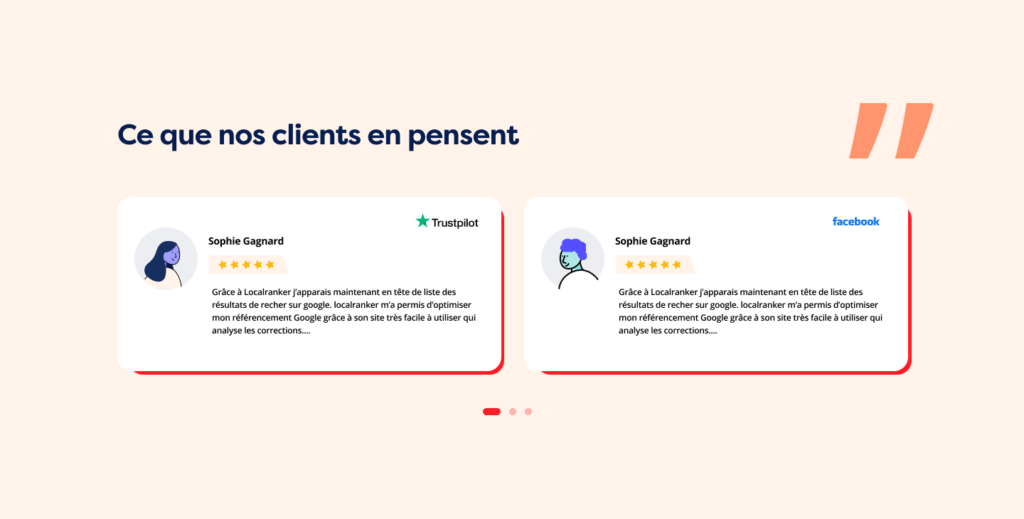
Third-party badges and certifications provide valuable external validation. Integrate the logos of recognized review platforms (Trustpilot, Google Reviews, Verified Reviews) along with your rating. This validation by independent third parties is particularly reassuring to visitors who are discovering your brand for the first time.
A successful landing page displays recent and up-to-date reviews. Testimonies dating back several years lose credibility and no longer embody your current offer. Automating the display of reviews then becomes essential.
Modern review management solutions allow you to dynamically integrate your best testimonials via widgets or APIs. You define selection criteria (minimum score, relevant keywords, publication date) and the system automatically updates the reviews displayed. This approach ensures that your landing pages always present your most current and positive image.
Also, consider implementing a testimonial rotation system. Instead of always posting the same 3 reviews, run a larger pool of positive testimonials. This variety prevents fatigue among recurring visitors and makes it possible to highlight different use cases depending on the context or the visitor segment.
For your customer reviews to have maximum impact, they must be technically optimized for search engines. Schema.org structured data allows Google to understand and display your reviews directly in search results as “rich snippets.”
Implement tagging AggregateRating to show your overall rating and total number of reviews. Those gold stars that appear in the SERPs dramatically increase the click-through rate (CTR) to your page - sometimes up to 35% more clicks.
For individual testimonies, use the schema Review which structures each review with its author, rating, date and content. Google can then select and display these reviews in the search results, increasing your visibility and credibility before the user even arrives on your page.
Regularly check the validity of your structured data using Google's rich results testing tool. Marking errors can not only deprive you of displaying stars, but can also be perceived as an attempt at manipulation by algorithms.
A landing page that converts should load in less than 3 seconds. Beyond that, you're gradually losing visitors - and potential conversions. The integration of customer reviews should never be at the expense of performance.
Optimize the loading of review widgets by using lazy loading: testimonials located further down the page only load when the user scrolls to them. This approach maintains the initial loading speed while still displaying all of your reviews to engaged visitors.
If you integrate reviews via third-party platforms (Trustpilot, Google), prefer asynchronous integrations that do not block the rendering of the page. A review widget that takes 5 seconds to load will penalize your entire page and frustrate your visitors.
For customer images in your testimonials, compress them systematically and serve them in modern formats (WebP) with descriptive alt attributes. Every millisecond saved in load time statistically translates into additional conversions.
More than 60% of e-commerce traffic now comes from mobile. However, many landing pages still neglect the mobile experience, especially when it comes to displaying customer reviews.
On mobile, space is precious. Adapt the format of your testimonies so that they remain readable without requiring zoom or horizontal scrolling. Long paragraphs become difficult to read: prefer more concise reviews or truncate testimonials with a “Read more” button.
Review carousels work particularly well on mobile, allowing multiple testimonials to be displayed in a limited vertical space. Ensure swipe gestures are smooth and intuitive, with clear visual indicators of the number of testimonies available.
Systematically test your landing pages on different devices and screen sizes. What works perfectly on a desktop can become unreadable or poorly organized on an iPhone SE or a large Android screen. The accessibility and readability of your reviews on all media directly condition your mobile conversions.
Paradoxically, a landing page displaying only 5-star reviews can arouse distrust. Knowledgeable consumers know that no product is perfect, and absolute perfection seems suspicious. An overall score between 4.3 and 4.7 out of 5 is generally perceived as more authentic and credible than a perfect 5/5.
Don't be afraid to post a few mildly critical reviews, especially if you've responded constructively. A 4/5 review mentioning a minor point of improvement, followed by your response explaining how you took this feedback into account, demonstrates your listening and your commitment to quality. Paradoxically, this transparency reinforces trust.
For more negative reviews (2-3 stars), manage them primarily on the original platforms rather than putting them forward on your landing page. Respond quickly and professionally, try to solve the problem, and turn the negative experience into a positive one if possible. A dissatisfied customer whose problem is resolved often becomes your best ambassador.
Use intelligent review routing: automatically direct satisfied customers (those who give 4 or 5 stars to a first question) to public platforms, while less positive feedback is directed to your customer service department for internal processing. This approach allows you to maximize your public rating while maintaining a complete feedback loop.
Not all of your visitors are at the same stage of maturity or have the same concerns. Customizing the reviews displayed according to the visitor's profile can significantly improve their relevance and therefore your conversion rate.
If your traffic comes from different sources (advertising, SEO, social networks), adapt the testimonies displayed to the context. A visitor arriving via an ad targeting large businesses should see case studies of similar customers, while a solo entrepreneur will appreciate testimonials from SMEs or solopreneurs.
Use behavioral data to refine the display. If a visitor has already visited your pricing page or downloaded a white paper, this is a strong signal of interest: show them testimonials focused on ROI and concrete results. On the other hand, for a first visit, prefer reviews that highlight ease of use and customer support.
Geographic segmentation can also play a role. Displaying French customer reviews to a French visitor, or mentioning well-known local brands, reinforces identification and proximity. This subtle customization increases the perception of relevance without additional effort on your part once the system is in place.
Beyond simply posting reviews, certain psychological principles can greatly amplify their impact on conversion.
Scarcity and urgency work particularly well coupled with reviews. Combine a positive testimony with a limiting element: “More than 500 brands trust us - Limited places for our launch offer”. This combination of social proof and urgency calls for immediate action.
The halo effect also works in your favor. If your reviews consistently mention a particular strength (for example, the quality of customer support), this positive trait will positively “contaminate” the overall perception of your offer. Identify your distinctive strength in customer feedback and amplify it in your selection of testimonials.
The anchoring of expectations via reviews determines the future experience. If your testimonies highlight the speed of implementation (“Operational in 48 hours”), new customers will arrive with this expectation - and will be even more satisfied if you stick to it. So make sure that the promises implicit in your reviews reflect your operational reality.
Creating a successful landing page is never a fixed project. Continuous optimization based on concrete data is the key to a sustainable improvement in your conversions.
The overall conversion rate is obviously still your main metric, but break it down to understand the levers for improvement. Measure the conversion rate according to the position of the reviews viewed: do visitors who scroll to your detailed testimonials section convert better? If yes, how do you encourage more visitors to reach this section?
Time spent on review sections indicates commitment and interest. Tools like Hotjar or Microsoft Clarity make it possible to analyze scroll behavior and heat zones (heatmaps). If visitors consistently skip your review section, it's because it's not visually appealing enough or poorly positioned.
The click-through rate on interactive testimonials (to read more, watch the video, check out the full case study) reveals the level of interest in your social proof. A low rate suggests either a lack of curiosity (the reviews posted are already convincing enough), or on the contrary a lack of attractiveness.
Reviews-assisted conversions can be tracked via Google Analytics events or your favorite analytics tool. Set up events to record interactions with your review widgets, then analyze the conversion journeys: what proportion of your converters consulted the reviews before taking action?
Systematic A/B testing is the scientific method for optimizing your landing pages. Every element related to customer reviews can and should be tested.
Test the location of the reviews: one version with testimonials at the top of the page versus another with reviews grouped below. Measure which placement generates the best conversion rate. However, be careful to segment your tests according to traffic sources - a placement can work differently for cold traffic (advertising) versus hot traffic (remarketing).
Experiment with different review formats. Compare classic text testimonials against video reviews, or simple star ratings versus detailed narrative testimonials. Each audience reacts differently, and only the test will tell you what resonates best with your visitors.
Vary the number of reviews displayed. Sometimes less is more: 3 ultra-targeted and powerful testimonials can outperform a long list of 20 average reviews. On the other hand, for certain sectors where quantitative social proof counts (number of users, volume of reviews), massively displaying your testimonies can be more reassuring.
Also, test the visual presentation: with or without customer photos, with or without a full name and company, verification badges, etc. These additional elements of trust can significantly impact the perceived credibility of your testimonials.
Your landing pages are not isolated islands - they are part of a complete ecosystem including your product, customer service, and feedback process. Create a virtuous loop where each element improves each other.
Analyze the reviews you collect to identify recurring pain points mentioned by your customers. If several testimonies mention a particular difficulty (even resolved), this is a signal that your landing page should anticipate and address this specific objection.
Use the insights from your reviews to enrich your content. The exact terms used by your happy customers are the best vocabulary for your copywriting. If your customers regularly say that your solution is “intuitive” or that “no technical skills are required,” incorporate these formulations into your titles and subtitles.
Ask for reviews specifically for your landing pages. After a successful conversion, ask for a targeted testimonial: “What convinced you to try us?” or “What concrete result did you get?” These tailor-made testimonies precisely address the doubts and questions of similar prospects.
Initial situation : Standard product landing page with description, photos, purchase button. Conversion rate: 1.8%.
Optimizations made :
Results : Conversion rate increased to 3.2% (+78%), with a significant increase in the average basket of 12%. Visitors viewing the detailed reviews section had a conversion rate of 5.7%.
Key lesson : Transparency pays off. The Bradery did not hesitate to also post a few 4/5 reviews mentioning points of attention (size, deadlines), which paradoxically reinforced trust rather than reducing it.
Initial situation : Free trial registration page focused on features, with testimonials at the bottom of the page. Conversion rate: 4.2%.
Optimizations made :
Results : Conversion rate increased to 7.1% (+69%), with a significant reduction in the bounce rate (-23%). Average time on page increased by 40%, a sign of increased engagement.
Key lesson : In B2B, numerical results and concrete case studies outperform generic testimonies. Visitors are looking to project themselves and need tangible proof of ROI.
Despite all good intentions, some recurring mistakes sabotage the effectiveness of customer reviews on landing pages.
Clearly false or too perfect reviews : Nothing destroys credibility more than testimonies that sound false. Avoid the “Best Product in the World!!! 10/10" anonymous. Always focus on authenticity, even if it means that some reviews are less enthusiastic but more credible.
Lack of audit evidence : Posting reviews without any verification badges or external sources creates doubt. Integrate logos from third-party platforms or mentions like “Verified Review” to reassure authenticity.
Reviews that are not dated or too old : Testimonials from 2019 suggest either that you no longer have happy customers or that you don't care about updating your content. Neither one nor the other inspires confidence. Aim for recent reviews (less than 6-12 months old) or, at the very least, mix old and new testimonials.
Overload of opinions at the expense of action : A landing page is not a review directory. If your visitor spends 10 minutes reading 50 testimonials without easily figuring out how to take action, you've failed. The balance between social proof and conversion guidance is crucial.
Non-responsive review on mobile : Unreadable testimonies on smartphones, a carousel that does not work with your finger, or videos that do not launch on mobile ruin the experience of more than half of your visitors. Test, test, and re-test on mobile.
Ignore negative reviews : Not responding to negative public reviews or leaving them untreated is a major mistake. Potential prospects also consult critical reviews, and your handling of these situations says a lot about your professionalism and customer service.
To truly exploit the potential of customer reviews on your landing pages on a large scale, automation tools are becoming essential.
Modern review management platforms such as Review Collect make it possible to automate the entire cycle: multi-channel collection (email, SMS, WhatsApp), intelligent routing of reviews according to their score, personalized automatic responses, and above all, dynamic integration on your landing pages via widgets or API.
Connect your review solution to your CMS or page builder (Shopify, WordPress, Webflow, etc.) so that new testimonials automatically feed your pages. This constant freshness reassures visitors and improves your SEO thanks to regularly updated content.
Also, integrate your analytics and tracking tools to precisely measure the impact of each review element on your conversions. Solutions like Google Tag Manager allow you to create personalized events to track each interaction with your testimonies.
The real power of customer reviews on your landing pages lies in the virtuous circle they create: the more you convert, the more satisfied customers you have, the more positive reviews you collect, the more your landing pages convert.
Systematize the collection of reviews from each new customer. Automatically send a review request 7 to 14 days after purchase or commissioning (optimal timing varies depending on your product). The higher your review volume, the more your credibility increases.
Encourage happy customers to leave detailed testimonials by inviting them to participate in case studies. A customer who sees their testimonial highlighted on your site becomes an even more committed ambassador for your brand.
Strategically reuse your best testimonials on several channels: landing pages of course, but also marketing emails, advertisements, social networks, and even in your sales presentations. This multi-channel consistency reinforces your message and maximizes the ROI of each review collected.
Creating landing pages that convert thanks to customer reviews is neither a mysterious art nor an exact science, but rather a discipline that combines psychology, design, technique and continuous optimization. Customer reviews are not simply ornaments of credibility: they are the fuel that turns skeptical visitors into convinced customers.
Remember that every visitor who lands on your landing page goes through a mental journey: from initial curiosity to interest, then to desire and finally to action. Customer reviews are used at each stage of this journey to reassure, convince and encourage decision making. Your role is to place them strategically and present them in an optimal way to maximize their impact.
Start small if you're just starting out: identify your priority landing page, gather your first authentic reviews, test different locations and formats, measure results, and iterate. Progressive improvement based on real data is always better than the hypothetical “perfect” redesign.
And never forget the golden rule: the best landing page optimization strategy is first to offer a product or service that genuinely deserves the 5-star reviews you want to display. Trust is earned through quality, and customer reviews are simply an amplified reflection of this.
Ready to turn your customer reviews into a conversion machine? Start today by auditing your current landing pages and identifying opportunities for strategic integration of your testimonials. Every improvement, no matter how small, will result in additional conversions — and growth for your business.
Learn how Review Collect can help you reach 4.9/5 stars in 30 days.
Receive our complete checklist to optimize your e-reputation in 15 days.