Do you need a GEO tool in 2027?
For most brands, no. A GEO tool measures your AI visibility but does not change it, and Google says optimizing for generative AI search is still SEO. Here are the best GEO tools, what they cost, and what to do first.
 Victor· Growth Hacker
Contents
- What does Google say about GEO?
- What do GEO tools actually measure (and what can't they fix)?
- Which GEO tools exist and what do they cost?
- When is a GEO tool worth paying for?
- What really makes AI systems recommend a brand?
- Why do customer reviews matter for AI answers?
- What is a free GEO stack for an e-commerce brand?
- How does Review Collect help?
TL;DR
- →Google's own guide says optimizing for generative AI search is still SEO
- →A GEO tool measures your visibility but moves nothing, and single-run scores are noisy
- →Before paying, run a manual 20-prompt test, fix your SEO and feed your customer reviews
No, not for most brands. GEO, short for Generative Engine Optimization, means optimizing so that AI assistants like ChatGPT, Perplexity and Google's AI answers cite your brand. A GEO tool tells you whether they mention you, but it does not make them mention you more, and Google says optimizing for generative AI search is still SEO. So before you pay $100 to $500 a month for a dashboard, run a manual 20-prompt test (a prompt is simply the question you put to the AI), then fix your SEO and feed your customer reviews.
If you searched "best GEO tools", you probably expected a ranked list. You will get one thing close to it: the prices of the main tools and free graders below, each checked on the vendor's official page. You will also meet two other labels: AEO (Answer Engine Optimization, the same idea under another name) and AIO (AI Overviews, the AI summary Google shows above results). But the argument matters more than the list. The tool is the smallest part of the problem.
What does Google say about GEO?
Google says that optimizing for generative AI search is the same job as optimizing for search, so it is still SEO. According to Google's current guide, the wording is direct: "From Google Search's perspective, optimizing for generative AI search is optimizing for the search experience, and thus still SEO." The page shows no publication date, so we cite it as the current version, read on 2026-11-10.
The same guide closes the doors that many vendors keep open. It says "You don't need to create new machine readable files, AI text files, markup, or Markdown to appear in Google Search". It adds "There's no requirement to break your content into tiny pieces for AI to better understand it." And on structured data: "Structured data isn't required for generative AI search, and there's no special schema.org markup you need to add." You can read all of it in Google's AI optimization guide.
The first consequence is practical. If Google sees no separate discipline, a tool sold as a separate discipline needs a better justification than "everyone is buying one".
What this does not prove
Google speaks for Google Search, AI Overviews and AI Mode. It says nothing about how ChatGPT or Perplexity pick their sources. So the honest reading is narrower than a slogan: on Google's surfaces, there is no hidden lever. On other assistants, nobody outside those companies can promise you one either. We come back to that gap further down, because it is where most GEO tool marketing lives.
What do GEO tools actually measure (and what can't they fix)?
GEO tools measure how often and how prominently AI assistants mention or cite your brand across a set of prompts. That works as a thermometer. But a thermometer does not lower the fever, and this one is less precise than its dashboard suggests.
The reason is that AI answers vary from one run to the next. In a paper on measurement ("Quantifying Uncertainty in AI Visibility", arXiv 2603.08924), Ronald Sielinski, the author of an arXiv preprint on how stable AI-visibility scores are, sampled Perplexity Search, OpenAI SearchGPT and Google Gemini on three consumer product topics. He found that "many apparent differences between domains fall within the noise floor of the measurement process" (the noise floor is the level of random variation below which a real change cannot be told apart from chance), and that "single-run visibility metrics provide a misleadingly precise picture of domain performance in generative search." The full text is on arXiv. In plain words: ask an assistant the same question several times and the answer changes from run to run, so a score taken from one run can mislead.
In practice, a chart that moves from 18% to 23% week over week may show nothing at all. By contrast, a tool that runs each prompt many times and reports a range is closer to honest. Ask any vendor how many runs sit behind one number. If they cannot answer, you have learned something.
What a tool cannot fix
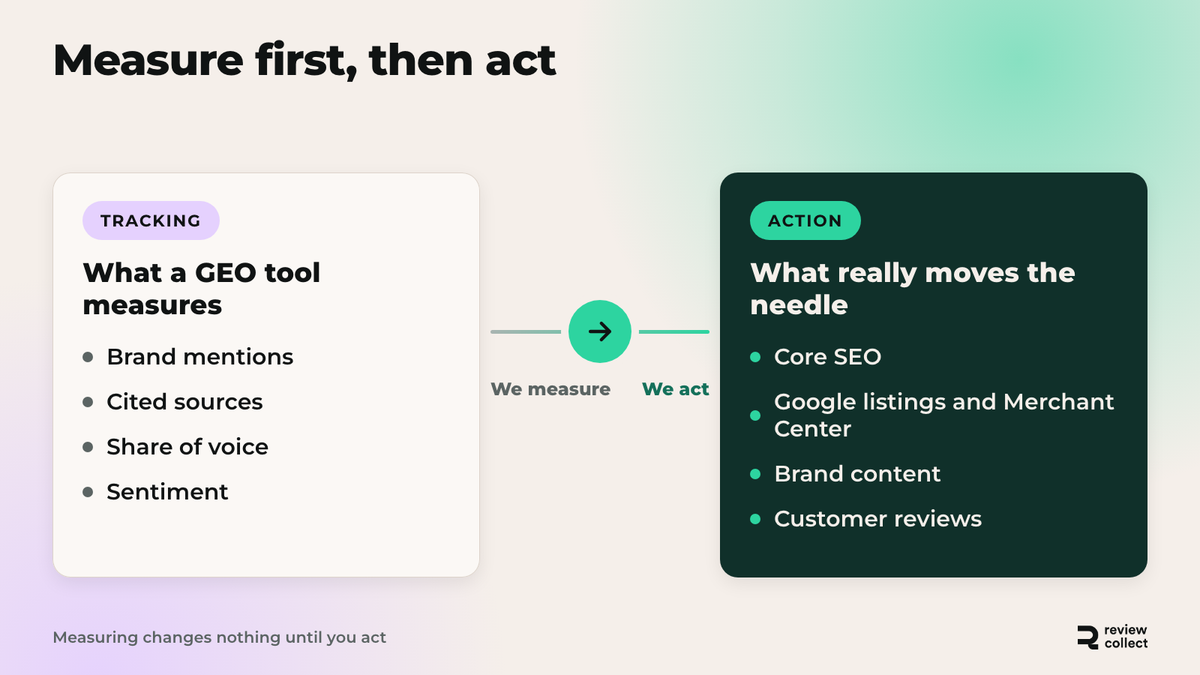
A GEO tool cannot rewrite your product pages, repair a Merchant Center feed, answer your reviews or earn you a mention in the press. It reports the gap. You still have to close it with ordinary marketing work, which is what the sections below are about.
Which GEO tools exist and what do they cost?
GEO tools range from free graders to custom enterprise contracts, and most self-serve plans land between $29 and $500 a month. We opened each vendor's official page on 2026-11-10 and recorded the entry price shown there. Where the page was unclear, the table says so. Prices change often, so check the page before you buy.
| Tool | What it does | Entry price | Source opened | Retrieved |
|---|---|---|---|---|
| Otterly | Tracks brand mentions across AI platforms by prompt | €29/mo (Lite, 16 prompts); €189 Standard; €489 Premium | otterly.ai/pricing | 2026-11-10 |
| Peec AI | Prompt-level visibility tracking | $95/mo (Starter, 50 prompts); $245 Pro; $495 Advanced. Page shows "$" without a currency code | peec.ai/pricing | 2026-11-10 |
| Ahrefs Brand Radar | AI visibility inside the Ahrefs suite | From $50/mo (Custom Prompts); $199/mo AI Visibility Index | ahrefs.com/brand-radar | 2026-11-10 |
| Semrush (SEO + AI Search plans) | AI prompt tracking bundled with SEO tools. No AI-only plan exists | "SEO + AI Search" Starter plan: €190/mo billed monthly, €158.40/mo billed annually | semrush.com/pricing | 2026-11-10 |
| Promptwatch | AI visibility tracking | $95/mo (Essential); $245 Professional; $579 Business | promptwatch.com/pricing | 2026-11-10 |
| AthenaHQ | AI visibility tracking | Free Essential plan (credits); $295/mo Starter | athenahq.ai/pricing | 2026-11-10 |
| Scrunch | AI visibility tracking | $250/mo billed annually, $300 month to month (Starter) | scrunch.com/pricing | 2026-11-10 |
| Profound | Enterprise AI visibility platform | Free trial; Enterprise on custom pricing, no public price | tryprofound.com/pricing | 2026-11-10 |
| HubSpot AI Search Grader | One-time brand check across ChatGPT, Perplexity, Gemini | Free, no account required for the analysis (the grader is free; the paid product is the next row) | hubspot.com/aeo-grader | 2026-11-10 |
| HubSpot AEO | Ongoing AI search tracking (the paid product, not the grader) | $50/mo, monthly price only. No HubSpot subscription required; included in Marketing Hub Pro and Enterprise | hubspot.com/aeo-grader | 2026-11-10 |
| Ahrefs Free AI Visibility Checker | Limited preview: mentions by platform, top 5 topics, top 5 cited pages | Free, top 5 results per section | ahrefs.com/ai-visibility-checker | 2026-11-10 |
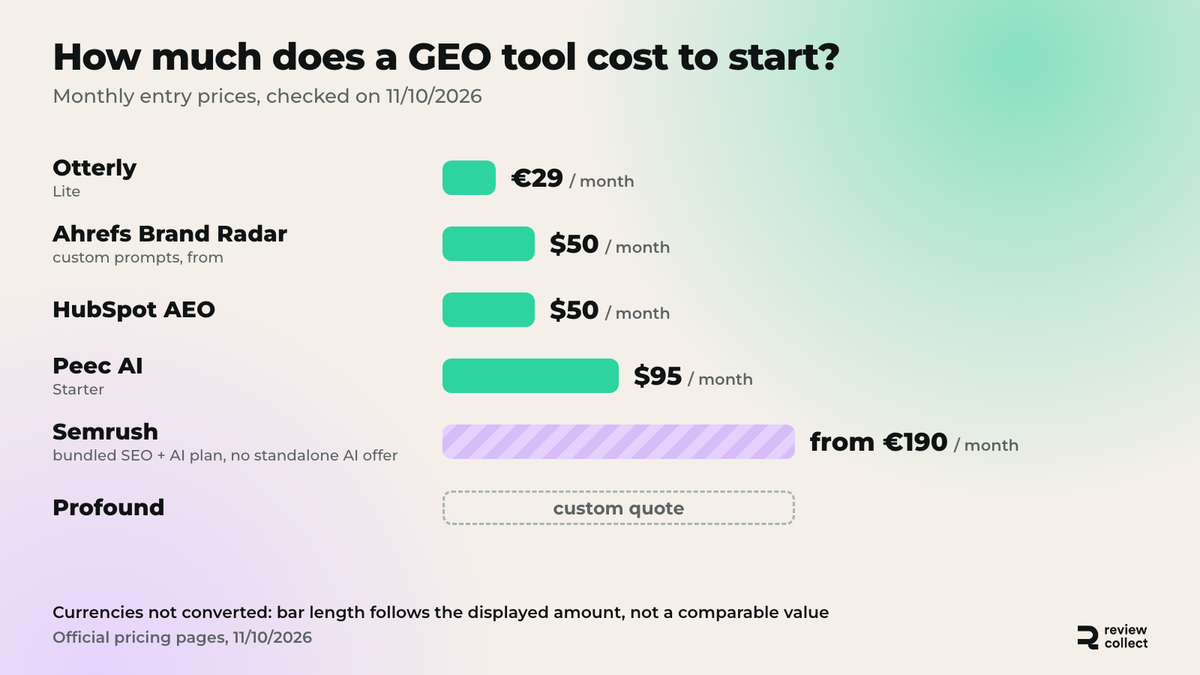
Two details deserve attention. First, the numbers in third-party roundups often differ from the vendor pages. A roundup we read listed Semrush's AI visibility at $189 and Profound at $99 to $399, while the official pages show something else. That is why every price above comes from the vendor's own page. Second, "entry price" hides the real cost. The cheapest tiers track a handful of prompts, so a brand with several product lines usually lands one or two tiers higher.
One more warning about names. HubSpot sells a free grader and a paid product that sound almost identical, and Semrush does not sell AI tracking on its own at all. Read the plan name before you read the price.
What a year of these tools costs
A monthly price looks small, but a year of it does not. Here is each entry price from the table multiplied by 12 (euro and dollar amounts are not converted, because the pages do not use the same currency):
| Tool and plan | Monthly | Per year |
|---|---|---|
| Otterly Lite (16 prompts) | €29 | €348 |
| HubSpot AEO | $50 | $600 |
| Ahrefs Custom Prompts | $50 | $600 |
| Peec AI Starter (50 prompts) | $95 | $1,140 |
| Peec AI Pro | $245 | $2,940 |
| Peec AI Advanced | $495 | $5,940 |
| Semrush "SEO + AI Search" Starter, billed monthly | €190 | €2,280 |
| Semrush, billed annually | €158.40 | €1,900.80 |
Semrush's annual billing saves €379.20, but only if you are sure you will still want the tool in month 12.
The manual test costs about two hours a month, or 24 hours over 12 months. Whether that is cheaper depends on what an hour costs you, so use your own rate. For most small teams, 24 hours is still well under $1,140.
So the price tag is not the real question. The real question is when that spend makes sense, which the next section answers.
When is a GEO tool worth paying for?
A GEO tool is worth paying for when measurement is your job or when manual tracking no longer scales. That covers three cases.
The first is an agency. If you report on AI visibility for several clients, a tool turns a half-day spreadsheet into a recurring deliverable, and the cost is billed on. The second is a large brand with many markets and product lines. Twenty prompts will not cover 40 categories in six languages, so you need automation and, ideally, repeated runs to get around the noise problem described above. The third is a team that already has strong SEO, a clean product feed and active review collection, and now wants to monitor competitors at scale.
Notice what these cases share. In each one, the tool serves a team that already does the underlying work. A brand with thin category pages, a messy feed and 40 reviews does not have a measurement problem. It has a visibility problem, and a dashboard will only confirm it every week for $245.
A decision grid
If you are unsure where you stand, find your situation below.
| Situation | Is a paid tool useful? | Why |
|---|---|---|
| Single brand, SEO base unfinished | No | The tool would confirm what you already suspect. Fix category pages, feed and reviews first. |
| Single brand, SEO solid, curious about AI mentions | Not yet | The manual 20-prompt test and the free checkers give the same signal at no cost. |
| Brand with 2 to 3 product lines, healthy SEO, wants a monthly trend | Maybe | An entry plan can save time, but check how many runs sit behind each number. |
| Agency reporting to several clients | Yes | Recurring reports are the product you sell, and the cost is billed on. |
| Multi-market brand, dozens of categories, several languages | Yes | Twenty manual prompts cannot cover that surface. You need automation and repeated runs. |
| Mature team that already fixed its basics | Yes | Monitoring competitors at scale is the next step, and the tool serves work that already exists. |
Notice that the "yes" rows all describe teams with the foundations in place. The tool never appears as the first move.
What five questions should you ask before paying for a GEO tool?
Five questions are enough to settle the decision. Answer them honestly.
- Have you already run the manual 20-prompt test? If not, you do not yet know what you would be paying to track.
- Do you have several brands or markets to follow? A single shop rarely needs automation, while many categories and languages do.
- Who will read the dashboard every week? A tool nobody opens is a monthly invoice, not a measure.
- What will you do with a score that changes from run to run? If you cannot act on a moving number, check how many runs sit behind it first.
- Do you already have recent, detailed reviews to build on? Reviews are one of the few levers you control, so they come before another subscription.
If you answer no to most of them, start with the manual test and the free tools. If you answer yes to most, a paid plan can start to make sense.
What really makes AI systems recommend a brand?
AI systems recommend brands they can find, understand and trust from sources they already consult, and for Google's surfaces those sources are the ordinary Search ecosystem. Google states it in its AI features documentation: "There are no additional requirements to appear in AI Overviews or AI Mode, nor other special optimizations necessary."
So the real levers are not new. Solid SEO comes first: crawlable pages, clear category and product content, and internal links that make sense. Next, the guide says that Merchant Center feeds and Google Business Profiles "can help your products and services to be visible in both AI responses and other Google Search results." And original content beats summaries. The guide notes that "a first-hand review provides a unique perspective based on personal experience", which is something a summary of existing pages cannot offer.
Other assistants behave differently, and we do not pretend otherwise. A large study by Chen et al. ("Navigating the Shift: A Comparative Analysis of Web Search and Generative AI Response Generation", arXiv 2601.16858) compares Google Search with leading generative AI services. According to its abstract, AI-generated answers and web search results differ substantially in the source domains they cite, the types of those domains, the query intent they address and the freshness of the information. We read only the abstract, so we use it for that and nothing more. The practical reading is to treat Google's guidance as solid for Google, and as a sensible default elsewhere. Our own solution for SEO, GEO and AEO rests on the same principle: one foundation, several surfaces.
GEO vs SEO: one block, one answer
People search "GEO vs SEO" as if the two were rivals. They are not. SEO is the discipline of being findable and trustworthy in search. GEO, as vendors use the word, is the same work aimed at AI answers, plus monitoring. The overlap is large enough that Google calls it SEO. The differences are measurement (mentions instead of rankings) and a few surfaces Google does not control. If you want the practical e-commerce playbook, we wrote a guide to GEO for e-commerce brands.
Why do customer reviews matter for AI answers?
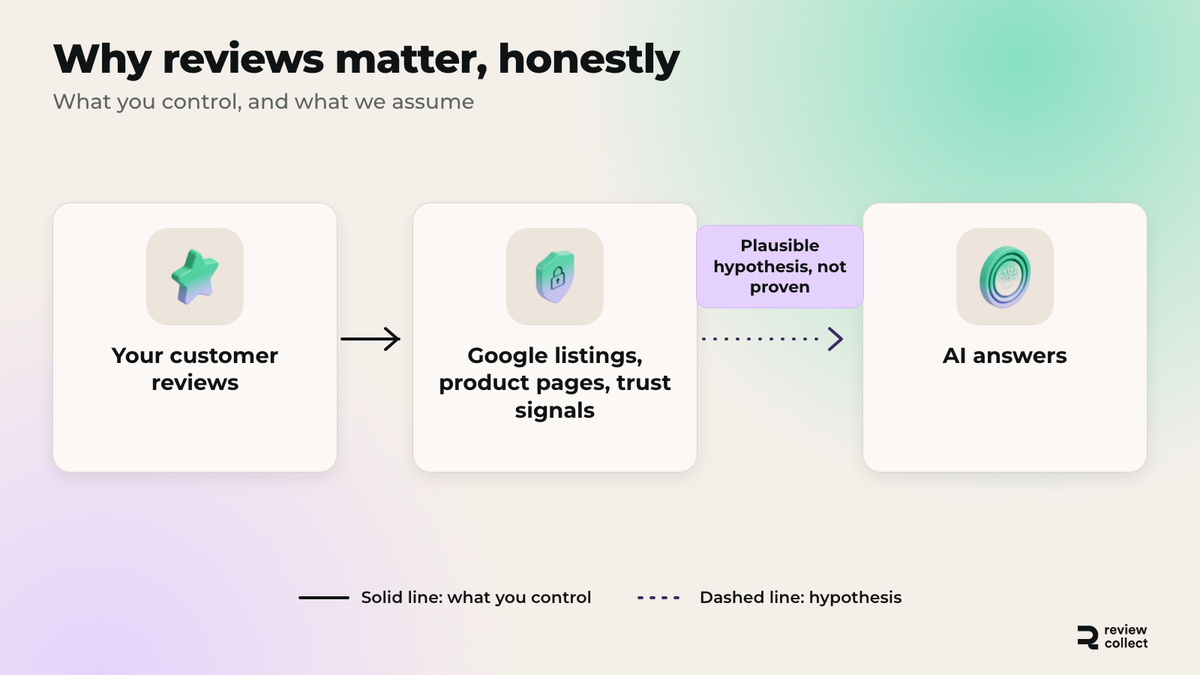
Customer reviews matter for AI answers because they feed the places AI systems and Google draw on: Google listings, Merchant Center and Shopping Graph data, and the trust signals around your brand. That is a plausible mechanism, not a proven one. We have not found a rigorous study that isolates the effect of review volume, recency or wording on AI citations, so we will not claim one.
What we can say is narrower and still useful. Google's guide stresses first-hand experience, and reviews are first-hand experience at scale, written by real buyers about real products. A product page with 400 recent reviews gives a system far more specific, current and varied language to work with than a page with three. Whether a given assistant uses that language is a question the evidence does not answer yet.


Build the review base before you buy a GEO tool
Fresh, plentiful reviews feed your Google listings and trust signals, without a separate tool for each channel.
- Collect reviews by email, SMS or WhatsApp, synced with delivery tracking
- Keep your reviews fresh and recent
- Get personalized replies to your reviews in 60 seconds
×30 reviews collected in the first month
An honest limit
Reviews are only part of the picture. In a study published in October 2025 by Yext, a vendor (6.8 million citations from more than 1.6 million AI responses across Gemini, OpenAI and Perplexity), reviews and social made up about 8% of cited sources, against 44% for brand websites and 42% for listings. So reviews do not replace your site or your listings. Their role is indirect: they feed your Google listings, product pages and trust signals. These figures use the vendor's own categories, and without further evidence nobody can claim more than that.
If you want to see how the wording of reviews can still help, we explain it in our article on how review semantics affect SEO, GEO and AEO.
What is a free GEO stack for an e-commerce brand?
A free GEO stack for an e-commerce brand is Google Search Console, Bing Webmaster Tools, GA4 and a manual 20-prompt check you run once a month. It costs nothing but about two hours, and it tells you most of what a $100 plan would.
Search Console shows the queries and pages that already earn impressions, which is the real base of your Google visibility. Bing Webmaster Tools matters because it shows how Microsoft's search engine crawls and indexes your site, and a broken sitemap there goes unnoticed if you only watch Google. GA4 lets you segment sessions that arrive from AI assistants, as long as the referrer is passed, so you can see whether AI traffic exists at all for your shop.
The manual 20-prompt test
Write 20 prompts a buyer would type: five categories of four prompts each: discovery ("best running shoes for flat feet"), comparison ("brand A vs brand B"), brand, purchase and problem. Run each prompt in ChatGPT, Perplexity and Google's AI Mode. The arXiv study above shows that single runs mislead, so repeat each prompt three times. Log in a spreadsheet whether you are named, cited with a link, or absent, and which domains appear instead.
Use this template to build your 20 prompts. It gives you five categories of four prompts each, so you cover the whole buying journey instead of only the flattering questions. Replace each bracket with your own product, brand or problem, and keep the wording close to what a real buyer would type.
| Category | Example prompts |
|---|---|
| Discovery | "What are the best [products] for [use case]?" · "Which [product type] should I buy for [need]?" · "Top [products] for [budget or profile]" · "What should I look for in a [product]?" |
| Comparison | "[Your brand] vs [competitor brand]" · "Is [your product] better than [alternative product]?" · "[Product type]: [brand A], [brand B] or [brand C]?" · "Differences between [your product] and [competitor product]" |
| Brand | "What do customers say about [your brand]?" · "Is [your brand] reliable?" · "What is [your brand] known for?" · "Does [your brand] have good customer service?" |
| Purchase | "Where can I buy [your product] with fast shipping?" · "Where can I buy [product type] online in [country]?" · "Is [your product] in stock at a trusted shop?" · "What is the return policy for [your brand]?" |
| Problem | "How do I fix [problem your product solves]?" · "What helps with [problem] at home?" · "What is the best way to avoid [problem]?" · "Which [product type] is best if I struggle with [problem]?" |
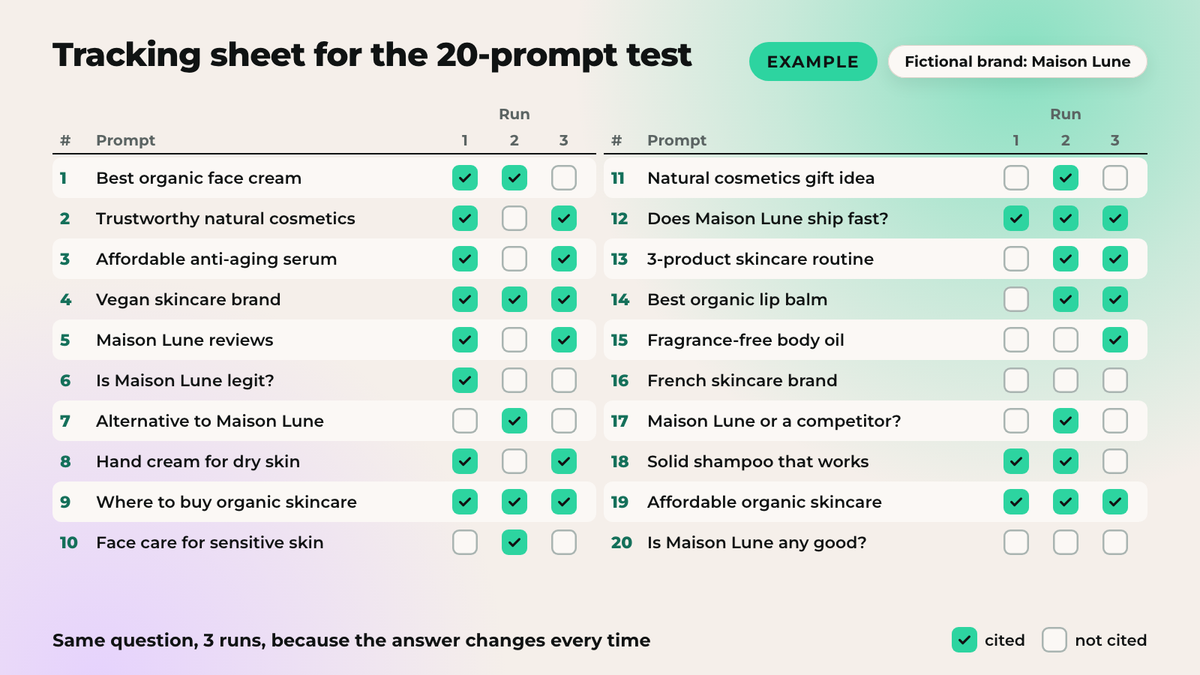
Here is how to read the log. Say your hypothetical brand is named in 1 of the 4 discovery prompts, in 3 of the 4 comparison prompts and in 4 of 4 brand prompts. The brand prompts prove the assistants know you exist. The discovery gap tells you the real problem: when a buyer has no brand in mind, you are not on the shortlist. The fix then sits on your category pages, your feed and the review volume behind your products, not in a subscription. If the same competitor domains keep appearing instead of you, open those pages and note what they have that you lack, such as comparison tables, answers to specific questions or hundreds of recent reviews.
After one month you have a baseline. Repeat monthly. Then compare the real cost with an entry price: $0 and two hours, against $1,140 to $5,940 a year for the $95 to $495 plans in the table.
How does Review Collect help?
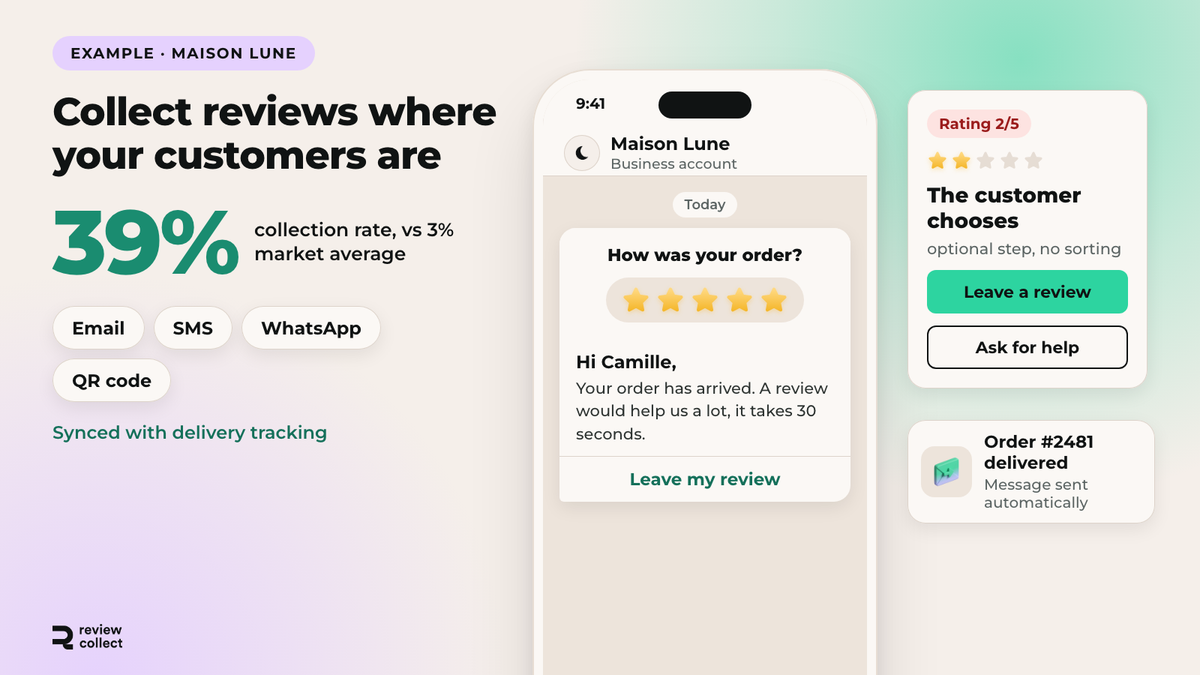
Review Collect is review collection software for e-commerce and multichannel brands, built to bring in a steady flow of recent, first-hand customer reviews. The one lever in this article that depends on your customers, and that you control, is your reviews. As said above, we cannot prove that reviews raise your AI mentions, we do not pretend they replace SEO, and we do not sell a promise of AI rankings. We collect reviews through email, SMS, WhatsApp and QR code, synced with delivery tracking, and distribute them to Google, Trustpilot and your product pages.
So the loop is simple. Your reviews feed your Google listings and trust signals, your SEO foundation stays active, and your manual test tells you whether the assistants notice. Our review collection software connects to more than 40 tools such as Shopify, Magento and Klaviyo, installs in 5 minutes and is configured the same day.
On collection, the number to know is the review collection rate: 39% with Review Collect, against 3% on average on the market. It measures how many customers leave a review, not how AI assistants behave.
$0 and two hours a month. The cost of the manual 20-prompt test, against $1,140 to $5,940 a year for the entry plans of paid GEO tools.



Your next order deserves a review. We take care of it.
SMS and WhatsApp collection, mediation for unhappy customers, AI replies on every published review. Live in 48 hours, no developer needed.
Free demo×30 reviews in the first month · A personalized AI reply to every review
Frequently Asked Questions
Analyze with AI
Ask your questions about "Do you need a GEO tool in 2027?" with your preferred AI

Growth Hacker
Your customers have reviews to give. We collect them for you.
20 minutes with a Review Collect expert. You leave with a concrete collection plan for your brand.