
Trustpilot Product Reviews: What the New Feature Means for E-Commerce Brands
Trustpilot now shows product ratings directly on public brand profiles. Here's what the feature changes for your online reputation, and how to use it without becoming dependent on a single platform.
 Victor· Growth Hacker
TL;DR
- →Trustpilot now displays a "Popular products" carousel with per-SKU ratings on public brand profiles.
- →Product reviews don't affect the overall TrustScore, but are publicly visible on Trustpilot.com.
- →The feature is limited to Advanced and Enterprise plans, with a real dependency risk if you collect reviews exclusively through Trustpilot.
- →A multi-channel collection tool lets you distribute reviews to your site, Google Shopping, and Trustpilot from one dashboard.
Trustpilot now shows product ratings directly on your public brand profile. Not just on your own website, not tucked inside a widget: on the page your prospects check before they buy. A poorly rated product is visible. A product with no reviews is too.
Here's what this actually changes, and how to handle it before your competitors do.
Service reviews vs product reviews: what's the difference on Trustpilot?
Trustpilot has always collected two types of reviews, but the distinction trips up a lot of brands.
Service reviews cover the overall purchase experience: delivery speed, customer support, returns, communication. When a customer rates you 4/5 after ordering, that's a service review. It's what feeds your TrustScore, the number displayed at the top of your profile.
Product reviews rate a specific item: its quality, how accurately it matched the description, its sizing. They're tied to a specific SKU, not to your brand as a whole.
The key difference: product reviews don't affect your TrustScore. Your overall rating stays the same whether a product is rated 5/5 or 2/5.
| Criteria | Service review | Product review |
|---|---|---|
| Covers | Overall purchase experience | A specific product |
| Who can leave one | Any invited customer | Customer who bought that product |
| Affects TrustScore | Yes | No |
| Where it appears | Trustpilot profile, widgets | Trustpilot profile (new), your website |
| Plan required | Free (limited) / paid | Paid plan (Advanced or Enterprise) |
Until recently, product reviews mostly served to fuel widgets on your own site. That's no longer the full picture.
What shoppers now see on your Trustpilot profile
Here's what changed: Trustpilot now displays a "Popular products" section directly on public brand profiles.
When a shopper visits your Trustpilot page, they now see a carousel of your most-reviewed products, each with its photo, name, and individual rating. A product with 5/5 from two reviews is visible. A product with 3/5 from two reviews is just as visible.
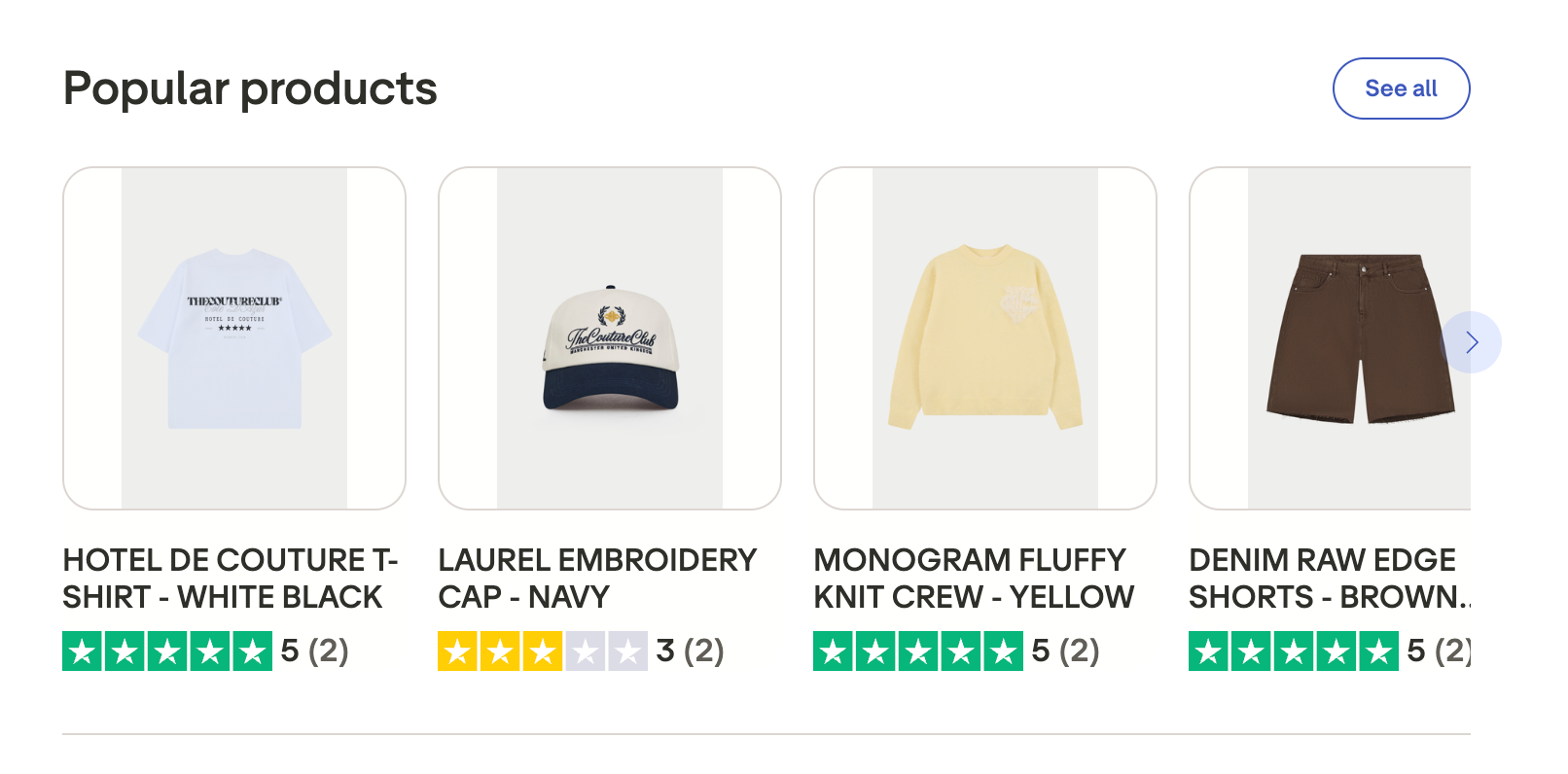
Each product gets its own dedicated page on Trustpilot.com: overall rating, review count, product description, and a "Shop now" button linking back to your store. The page is public, indexable, and visible to anyone.
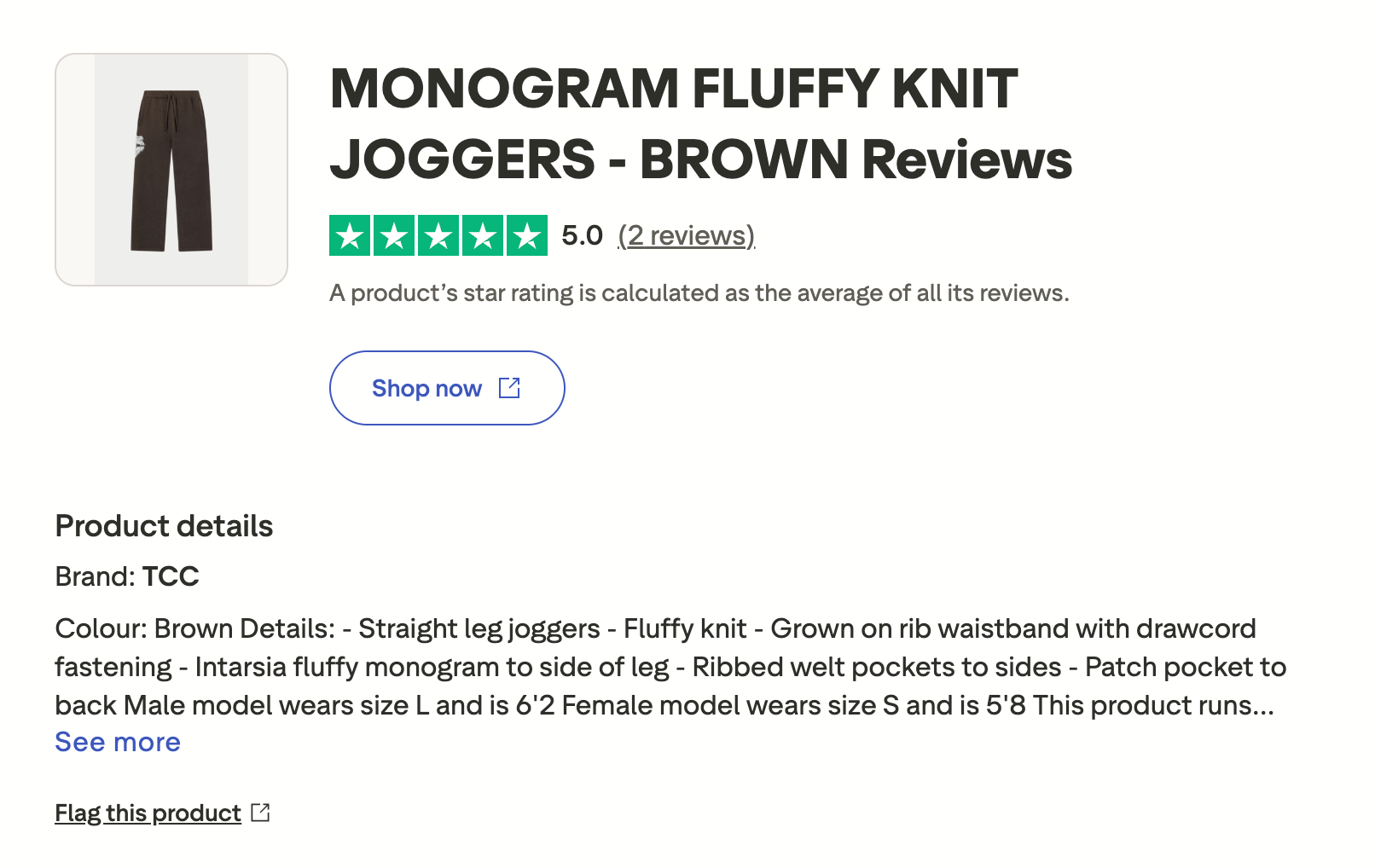
This has a direct consequence: your product reviews are no longer internal data you choose whether to display on your site. They become a public storefront on a platform you don't control.
According to an Ifop study (January 2026), 93% of consumers check reviews before buying. A product section visible on your Trustpilot profile is now part of that decision path.
Why Trustpilot is making this move
Trustpilot is no longer just a reputation verification platform. It's positioning itself as a product discovery destination, modelled on Amazon or Google Shopping.
The logic is straightforward: the more shoppers stay on Trustpilot to browse product ratings, the more indispensable it becomes in the purchase path. For brands, it creates pressure to adopt the feature, which is only available on paid plans (Advanced and Enterprise).
For you, there are two immediate consequences.
First: if your competitors activate product reviews and you don't, their carousel appears on their profile and yours stays empty. In a competitive category, a missing product section starts to look like a confidence gap.
Second: you don't control which products appear in the carousel. Trustpilot surfaces the most-reviewed ones. If your first product reviews land on a weak item, that's what leads your public profile.
What to do now
Three concrete steps, in order.
1. Check your Trustpilot plan
Product reviews aren't available on the free plan or the Standard plan. Confirm with Trustpilot what your contract includes before investing time in collection.
2. Build a base before you activate
Don't go live empty. One product with a single 3/5 review on your public profile does more damage than no section at all. Before activating, identify your 5 to 10 products with the strongest satisfaction rates and run a targeted collection campaign on those SKUs first.
3. Don't put all your product reviews in one basket
Reviews collected through Trustpilot stay in Trustpilot. You can't export them, redistribute them on your site outside of TP widgets, or use them on Google Shopping or other channels. If you depend on a single platform for your product reviews, a change in their terms or a price increase hits you directly.
Collect product reviews across all platforms
Don't let Trustpilot be your only source. Review Collect sends your product reviews to your site, Google Shopping, and Trustpilot from a single dashboard.
- Automatic post-purchase collection
- Multi-channel distribution in one click
- 30× more reviews in your first month
Pitfalls to avoid
Low ratings visible to everyone
Trustpilot displays product ratings as-is, no filtering. A 3/5 product with two reviews shows up in your carousel if no other customers have been invited to review it. Before activating the feature, check actual satisfaction data for every SKU you plan to promote.
Mixing up TrustScore and product ratings
Both are visible on your profile, but they work differently. A shopper can easily see a TrustScore of 4.7 alongside product ratings at 3/5. The gap is visible and creates confusion. Managing both requires a separate collection strategy for each.
Leaving most of your catalogue without reviews
If you have 200 products and only 10 have reviews, the other 190 sit there with no data. On a Trustpilot profile, product pages without reviews exist but offer nothing reassuring. Plan your collection in waves, starting with your best-sellers.
Single-platform dependency
It's a systemic risk many brands underestimate. Trustpilot has changed its terms of service multiple times in recent years. The reviews you collect through their API belong to their ecosystem. If your contract changes, you start from scratch everywhere else.
Collecting product reviews without platform dependency
Trustpilot's new feature is real and worth taking seriously. Building it as your only product review source is the riskier move.
Review Collect collects product reviews from your Shopify, WooCommerce, or PrestaShop store and distributes them where they matter: on your site, in your product pages, to Google Shopping, and to Trustpilot. One collection flow, multiple display points. See how review centralization works.
Brands using this multi-channel approach collect an average of 30 times more reviews in their first month. Automatic collection on every order, by email or WhatsApp depending on the customer, replaces manual campaigns.
Your Trustpilot profile benefits from reviews collected through Review Collect. So do your product pages. And if a platform changes its rules tomorrow, your data isn't held hostage.
Frequently Asked Questions
Analyze with AI
Ask your questions about "Trustpilot Product Reviews: What the New Feature Means for E-Commerce Brands" with your preferred AI

Growth Hacker