
SMS and Email for Review Collection: The Sequence That Works
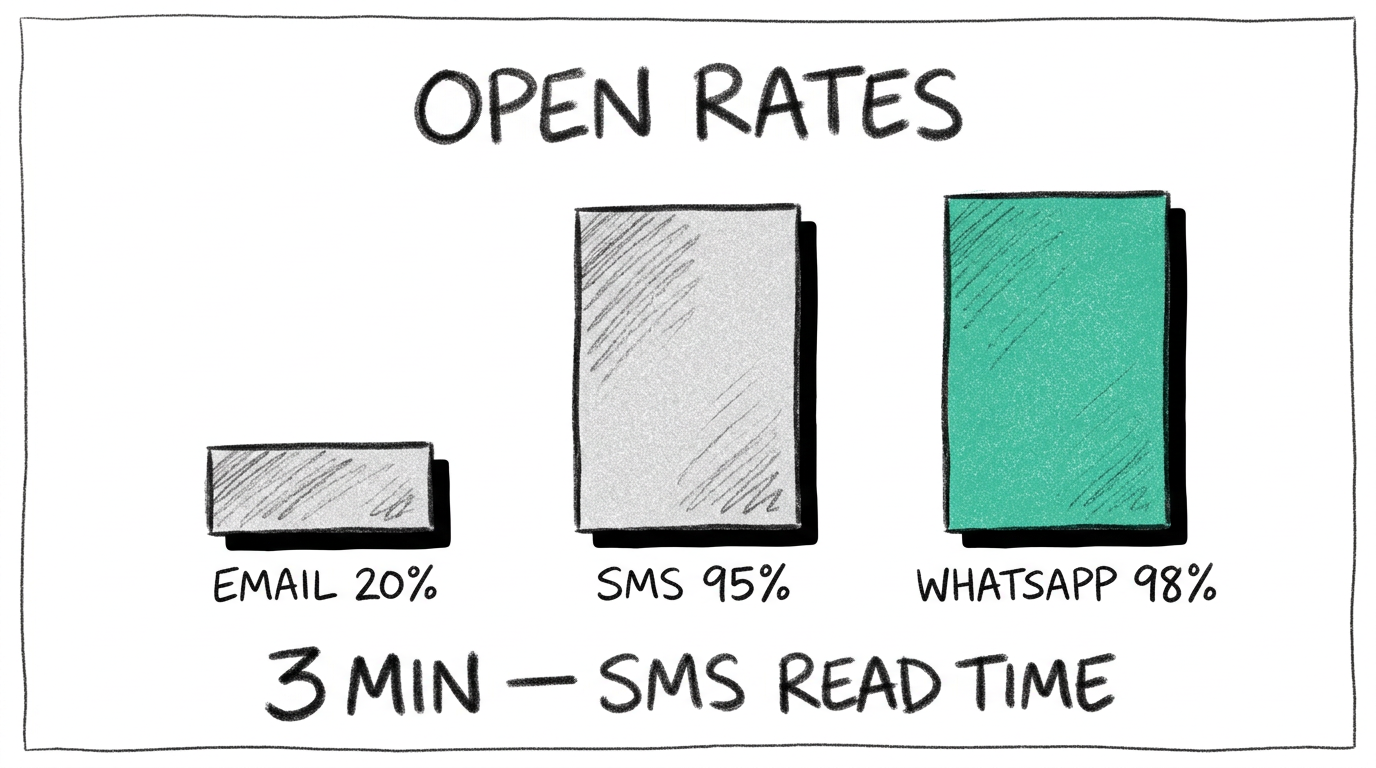
Your review request emails hit a 20% open rate. Your SMS hit 98%. Used in the right order, these two channels can take you to a 39% response rate. Here's how to build that sequence, and why WhatsApp is the logical next step.
 Victor· Growth Hacker
Contents
- What results do SMS and email deliver for review collection?
- When should you send an email or SMS to request a review?
- What email, SMS and WhatsApp sequence maximizes review collection?
- 5 SMS templates + 3 email templates ready to copy
- What does 2026 compliance change for SMS marketing?
- How Review Collect automates your email + SMS + WhatsApp sequence
TL;DR
- →Email: 20% open rate. SMS: 98%. The right question isn't the channel. It's the sequence.
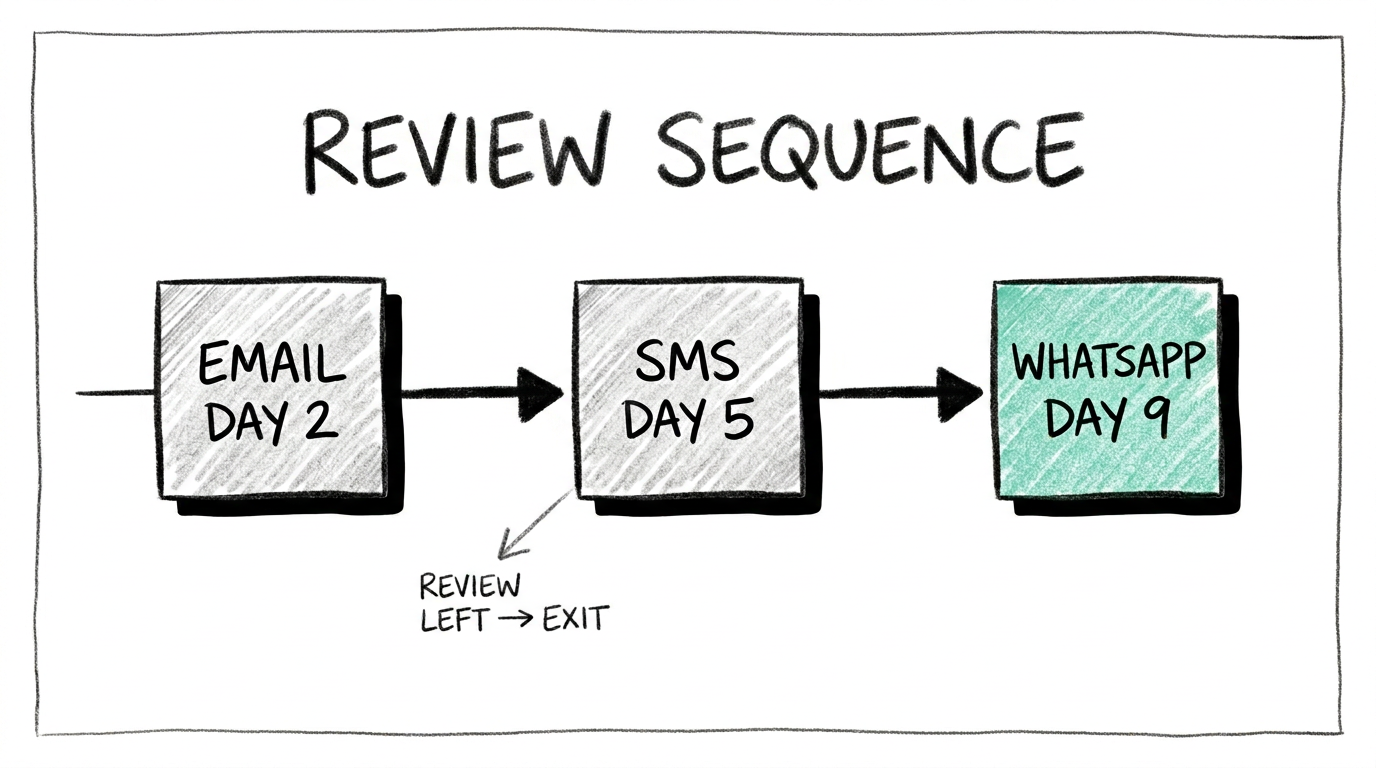
- →Validated sequence: Email Day 2, SMS Day 5, WhatsApp Day 9, with automatic exit when a review is posted.
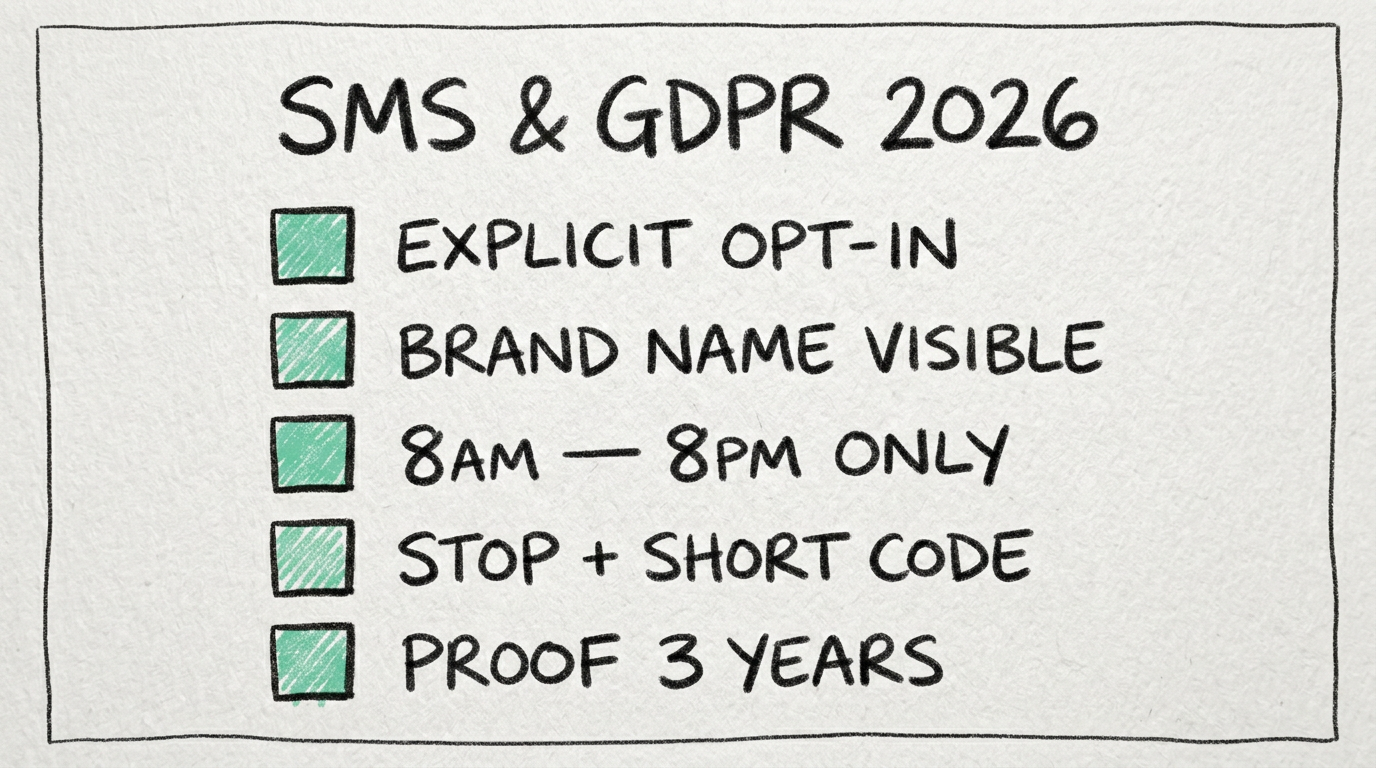
- →AF2M Charter 2026 requires explicit unchecked-box opt-in, 8am-8pm sending hours, and 3-year consent records.
- →39% average response rate with automated email + SMS sequences via Review Collect.
Your review request emails disappear. You know it. Out of 100 customers contacted, 80 never even open the message. SMS performs better, but used badly, it irritates. The right question is not "SMS or email?" It is "in what order, when, and with what message?" That's the sequence we're going to build, channel by channel, with templates included.
What results do SMS and email deliver for review collection?
Email remains the most widely used channel for review collection. It’s also the least effective on the only metric that matters: response rate.
| Channel | Open rate | Response rate | Average read time | Opt-in required | Cost |
|---|---|---|---|---|---|
| 20-25% | 2-5% | 6 to 12 hours | B2C opt-in | Low | |
| SMS | 90-98% | 15-25% | Under 3 minutes | Explicit opt-in | Moderate |
| 98% | 30-45% | Under 5 minutes | Double opt-in | Moderate |
90% of SMS messages are read within the first 3 minutes of receipt. A review request email waits an average of 6 hours before being opened. When it is.
These numbers don't mean email is dead. They mean you're probably using email where SMS would give better results, and vice versa.
Why does email remain essential despite its low rates? Because it’s the only channel where you can afford context: explain, reassure, personalize with a product image, include multiple links. A post-purchase email with the product photo, the customer’s first name, and a direct button to Google outperforms a generic email every time. SMS doesn’t have that space. It has to be short, direct, and ask for one thing only.
This isn't a competition between two channels. It's a sequencing question.
When should you send an email or SMS to request a review?
The channel choice depends on three variables: the type of customer experience, the trigger delay, and the industry. Here are the practical rules.
| Trigger | Recommended channel | Optimal timing | Why |
|---|---|---|---|
| E-commerce product delivery | Day 2 after delivery | Customer has had time to test. A longer email is welcome | |
| In-store service | SMS | Day 0 to Day 1 | Experience is fresh, short SMS works well |
| Resolved support ticket | 24h after closure | Customer needs time to step back | |
| Restaurant / café booking | SMS | 2h after the experience | Context still present, ultra-short message |
| Complex service project | Email then SMS | Email Day 2, SMS Day 5 | Complexity justifies email, SMS follow-up if no reply |
| Installation / setup | Day 7 | Product has been tested over time | |
| SaaS subscription (first month) | Day 30 | Evaluation based on usage, not onboarding |
SMS is your follow-up channel, not your first-contact channel for online purchases. Sending an SMS the day after an order, before the delivery, is the opposite of what you should do. The customer hasn't received their product yet. Worse: if delivery is delayed, you've just created unnecessary friction.
Email is your opening channel, not your volume channel. Its 20-25% open rate is a structural limitation, not a copywriting problem. You can optimize the subject line, test send times, personalize content. You won't sustainably exceed 35-40%. That's not enough to build a steady review flow from email alone.
What email, SMS and WhatsApp sequence maximizes review collection?
The principle is simple: each channel occupies a position in the sequence, with a specific role. Email opens. SMS follows up. WhatsApp closes. You're not bothering the same customer three times with the same message. Each channel brings something different, at a different moment.
Sequence for e-commerce:
- Day 2 after confirmed delivery: personalized email with first name, product name and direct link to the platform. Short subject, no multiple questions, one CTA only.
- Day 5, no response: follow-up SMS, 160 characters max, short tracked link, one possible action. No justification, no filler phrases.
- Day 9, still no response: WhatsApp if opt-in obtained. Conversational message, less formal than email, longer than SMS.
Sequence for in-person services (restaurants, beauty, automotive, tradespeople):
- Day 0 within 2 hours: short, warm SMS. The experience is still fresh.
- Day 3, no response: email with more context, link to Google Maps or the review platform, option for enriched feedback if something went wrong.
This isn't harassment. It's relevance. A customer who enjoyed their experience but didn't reply to the email isn't trying to ignore you. They were interrupted, or the email landed in promotions. The SMS puts the topic back in their mind at the right moment, without repetition.
The golden rule of the sequence: as soon as a customer posts a review, they exit the sequence. They don't receive the follow-up SMS, they don't receive the WhatsApp. This seems obvious, but it's the most common error for teams managing this manually: the customer receives the follow-up SMS after they already posted their review two days earlier. Result: a bad experience on top of a good one.
And where does WhatsApp fit in?
WhatsApp isn't a bonus channel. It's the most effective of the three: 98% open rate and response rates between 30 and 45%. It has one prerequisite: explicit opt-in. Without that consent, you can't use it.
When the conditions are met, WhatsApp changes the game for review collection. The conversational format reduces the distance between brand and customer. A WhatsApp message feels like a message from a friend, not a marketing email. The customer responds more spontaneously.
In a well-built email + SMS + WhatsApp sequence, WhatsApp captures what the first two channels failed to trigger. These are often your most mobile-active customers, the most likely to have a strong opinion about your product.
For a deep dive into WhatsApp for review collection, setup, Meta-approved templates, and specific regulations, our full guide is here: How to use WhatsApp Business to collect customer reviews.
Email + SMS + WhatsApp from one dashboard
Review Collect deploys the sequence automatically: no manual delay configuration or sending hours to manage.
- Automatic post-delivery trigger
- Review SMS with STOP opt-out built in
- Sequence exit as soon as a review is posted
5 SMS templates + 3 email templates ready to copy
These templates respect the 160-character SMS constraint. Beyond this limit, the message splits into two SMS and gets billed double by most carriers. Each template was designed for a specific situation: don't mix them up.
Why shorter templates perform better
The temptation is to explain, thank at length, over-personalize. In practice, the shorter the SMS, the higher the click rate. The customer understands in one second what you're asking. The only information that matters in a review request SMS: who you're addressing, why you're reaching out now, and a single link to act.
SMS templates:
Template 1, post-delivery e-commerce, neutral tone:
Hi [First name], your [Product] order has arrived. A review from you helps a lot: [Link]. Thanks! Reply STOP to unsubscribe.
Template 2, in-store service, direct tone:
[First name], thanks for visiting [Brand] yesterday. 30 seconds to rate us? [Link]. Reply STOP to unsubscribe.
Template 3, resolved support ticket:
Hi [First name], your request has been handled. If everything's good, a review would help us: [Link]. Have a great day. Reply STOP to unsubscribe.
Template 4, follow-up after email with no reply:
[First name], we reached out by email last week. A quick rating on [Link]? Thanks in advance. Reply STOP to unsubscribe.
Template 5, restaurant or immediate service:
Thanks for visiting [Brand] tonight! Your review matters to us: [Link]. See you soon! Reply STOP to unsubscribe.
Email templates:
Email template 1, clean and direct (e-commerce, post-delivery):
Subject: [First name], we'd love your feedback on [Product] Hi [First name], Your [Product] order arrived a few days ago. If you've used it, a quick review helps other customers choose and helps us improve: → [Button: Leave a review on Google] Thank you for your trust. [Brand team signature]
Email template 2, with product context and image:
Subject: How did your [Product] go? Hi [First name], 48 hours ago you received [Product]. [Product image or order visual] Whether the experience went well or something wasn't perfect, your feedback is valuable to us and future buyers: → [Button: Leave my review] It takes less than a minute. [Signature]
Email template 3, after closed support ticket:
Subject: Your request is resolved. A word from you? Hi [First name], Your request from [Date] has been handled and closed. If our team met your expectations, a review would mean a lot: → [Button: Leave a review] And if something wasn't right, reply directly to this email. We'd rather fix the issue before it ends up elsewhere. [Signature]
The third template has an important detail: the invitation to reply directly if the customer isn't satisfied. This isn't review gating (prohibited under the EU Omnibus Directive). It's preventive mediation: you give a dissatisfied customer an outlet before they post a negative review by default.
What does 2026 compliance change for SMS marketing?
Since March 2026, the AF2M Charter (French Mobile Marketing Association) more strictly governs commercial SMS communications in France. These rules add to GDPR and existing CNIL recommendations. For the UK, ICO and PECR apply similar requirements. In the US, TCPA and CTIA guidelines govern SMS marketing consent. None of this is optional.
What the AF2M Charter 2026 requires for SMS marketing:
- Explicit opt-in required: the customer must have checked an unchecked box at signup or purchase. A purchase alone does not constitute implicit consent for SMS.
- Clear sender identification: the brand name must appear in the message body, not just in the sender number.
- Regulated sending hours: commercial SMS are prohibited before 8am and after 8pm, and banned on Sundays and public holidays in France.
- Immediate unsubscribe: every SMS must include a STOP mention followed by a dedicated short number. Unsubscribes must be processed within 24 hours.
- Consent records: keep proof of consent for a minimum of 3 years.
The most commonly violated rule is the first: many online stores pre-check the "receive our promotional SMS" box. Since March 2026, this practice exposes companies to CNIL penalties in France.
| Channel | Consent required | Mandatory legal mention | Regulated hours | Records to keep |
|---|---|---|---|---|
| B2C opt-in (soft) | Unsubscribe link | No | Recommended | |
| SMS | Explicit opt-in (unchecked box) | STOP + short number | 8am-8pm, excl. Sun. and holidays | 3 years mandatory |
| Double opt-in (WA Business API) | Not formally regulated | Not regulated | Recommended |
SMS is the most regulated of the three channels. It's also the one that, used correctly with proper consent, delivers the best results in review volume. These two realities go together: the consent requirement naturally selects your most engaged customers.
How Review Collect automates your email + SMS + WhatsApp sequence
Manually configuring and managing an email-SMS-WhatsApp sequence takes time and creates mistakes: sending an SMS to a customer who already replied to the email, triggering a WhatsApp follow-up on Sunday at 10pm, forgetting the STOP mention. Review Collect automates the entire sequence from your Shopify store, WooCommerce, Brevo, or CRM.
How it works in practice:
- The post-purchase trigger fires automatically at delivery confirmation, or at the service date for service providers.
- Review Collect sends the Day 2 email with the review link to your platform of choice: Google, Trustpilot, Verified Reviews, or your Review Collect brand page.
- If no review is posted within 72 hours, the follow-up SMS goes out automatically, with STOP mention, sending hours verified, and immediate sequence exit if a review is detected in the meantime.
- For customers with WhatsApp opt-in, a WhatsApp Business API message can go out at Day 9, with a conversational format different from the SMS.
- Customers who unsubscribe are immediately removed from all sequences, across all channels.
No manual delay configuration. No sending hours to verify. No risk of sending a follow-up SMS to a customer who already posted their review.
Customer results: 39% average response rate on email + SMS sequences, versus 2-3% for email-only collection. Some accounts go from fewer than 10 reviews per month to over 300 in 30 days. The full breakdown is here: Triple your customer reviews in 30 days. The difference isn't the channel. It's the sequence, built right, that stops at the right time.
In B2B and SaaS, email + WhatsApp sequences follow the same logic but the triggers are different: renewal, measurable success, onboarding day 30. Full strategy in B2B SaaS review collection: how to automate it.
Frequently Asked Questions
Analyze with AI
Ask your questions about "SMS and Email for Review Collection: The Sequence That Works" with your preferred AI

Growth Hacker
Related articles
RCS for customer review collection: what changes in 2026
Aug 10, 2026
B2B and SaaS Customer Reviews: Why They're Harder to Collect (and How to Automate Them)
Aug 3, 2026
Social Proof Marketing: Definition, Types, and How Customer Reviews Make It Work
Jul 23, 2026