
Preventive Mediation for Customer Reviews: Stop Negative Reviews Before They're Posted
72 hours separate a dissatisfied customer from a published 1-star review. With preventive mediation, you step in first. The 3 warning signals, the method, and measured results (-40% 1-star reviews).
 Victor· Growth Hacker
TL;DR
- →Preventive mediation detects at-risk customers before they post, not after.
- →3 key signals: NPS < 6, unresolved support ticket > 48h, delivery delay with no update.
- →93% of contacted customers choose to resolve privately rather than post a negative review.
- →-40% 1-star reviews in 90 days for Review Collect customers with active mediation.
72 hours. That's the average window between a dissatisfied customer and a 1-star review going live. With a preventive mediation system, you intervene within that window before the review is published. Measured result across Review Collect customers: -40% 1-star reviews.
What is preventive mediation in customer review management?
Preventive mediation in customer review management means detecting dissatisfaction signals before a customer posts a negative review, then triggering an intervention to resolve the issue privately.
It's not review gating. Review gating creates a conditional barrier to publishing: satisfied customers go to review platforms, dissatisfied ones get routed to an internal form. That practice is banned by Trustpilot, Google, and the EU Omnibus Directive.
Preventive mediation offers an alternative. It blocks nothing. 93% of dissatisfied customers contacted within the first 24 hours choose to resolve their issue with customer support rather than post a negative review — not because they're prevented from doing so, but because they have a better option.
The 3 signals that precede a negative review
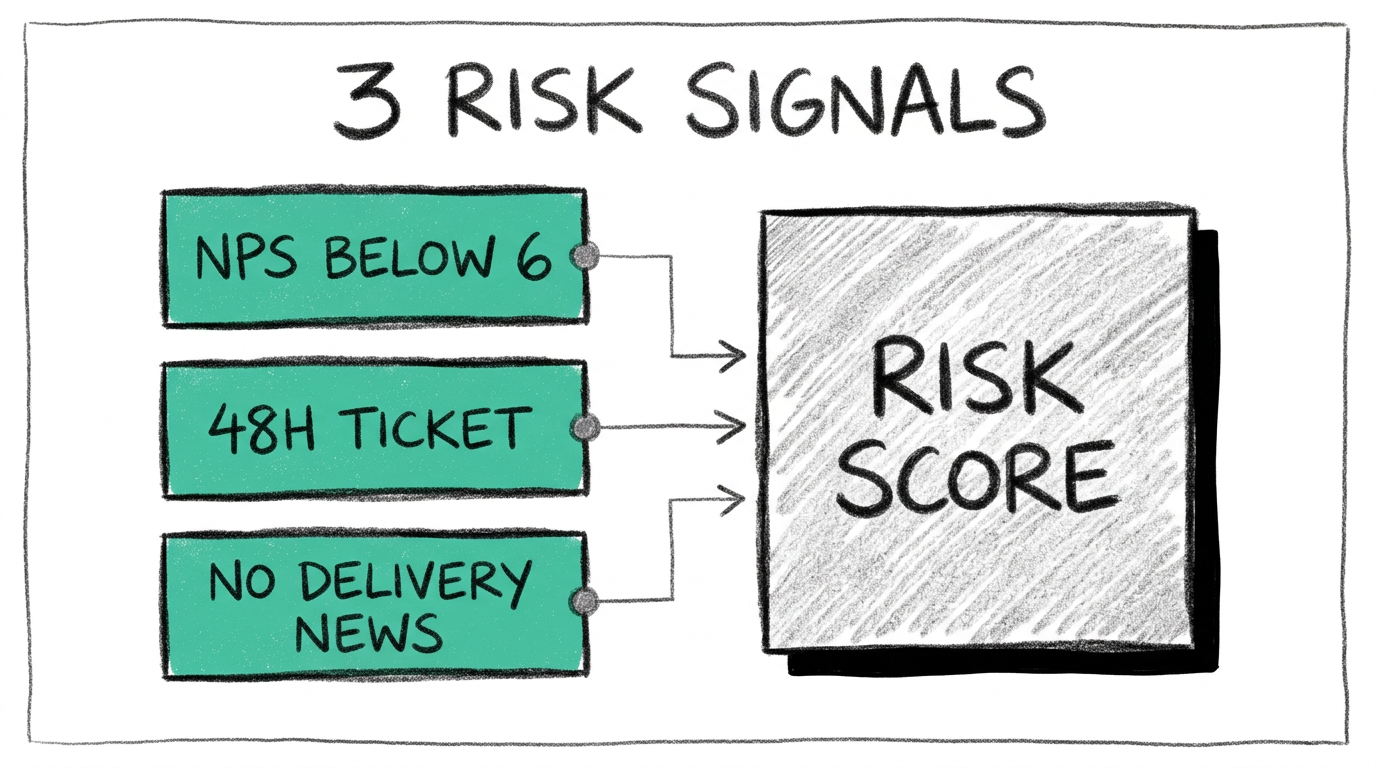
A dissatisfied customer leaves traces before posting. Three indicators are particularly reliable:
NPS score below 6. A customer who responds 5/10 or lower on a satisfaction survey is a latent detractor. Without intervention, they're 3× more likely to leave a 1-star review within 7 days.
Support ticket unresolved past 48 hours. An unaddressed problem builds frustration. After 48 hours without a visible resolution, the risk of a negative review goes up sharply.
Delayed delivery with no communication. The most frequent signal in e-commerce. The customer isn't angry about the delay — they're angry about the silence. A proactive message changes the outcome.
These three signals, crossed with purchase history and customer behaviour, allow you to build a reliable risk score well before any review is published.
| Signal | Concrete indicator | Critical window | Recommended action |
|---|---|---|---|
| NPS score < 6 | Latent detractor after satisfaction survey | 7 days | Agent alert + proactive outreach |
| Support ticket unresolved > 48h | Accumulated frustration, no visible response | 48–72h | Automatic escalation + follow-up |
| Delivery delay with no communication | Customer feeling ignored | 24–48h | Proactive message + discount code |
The intervention window: 72 hours
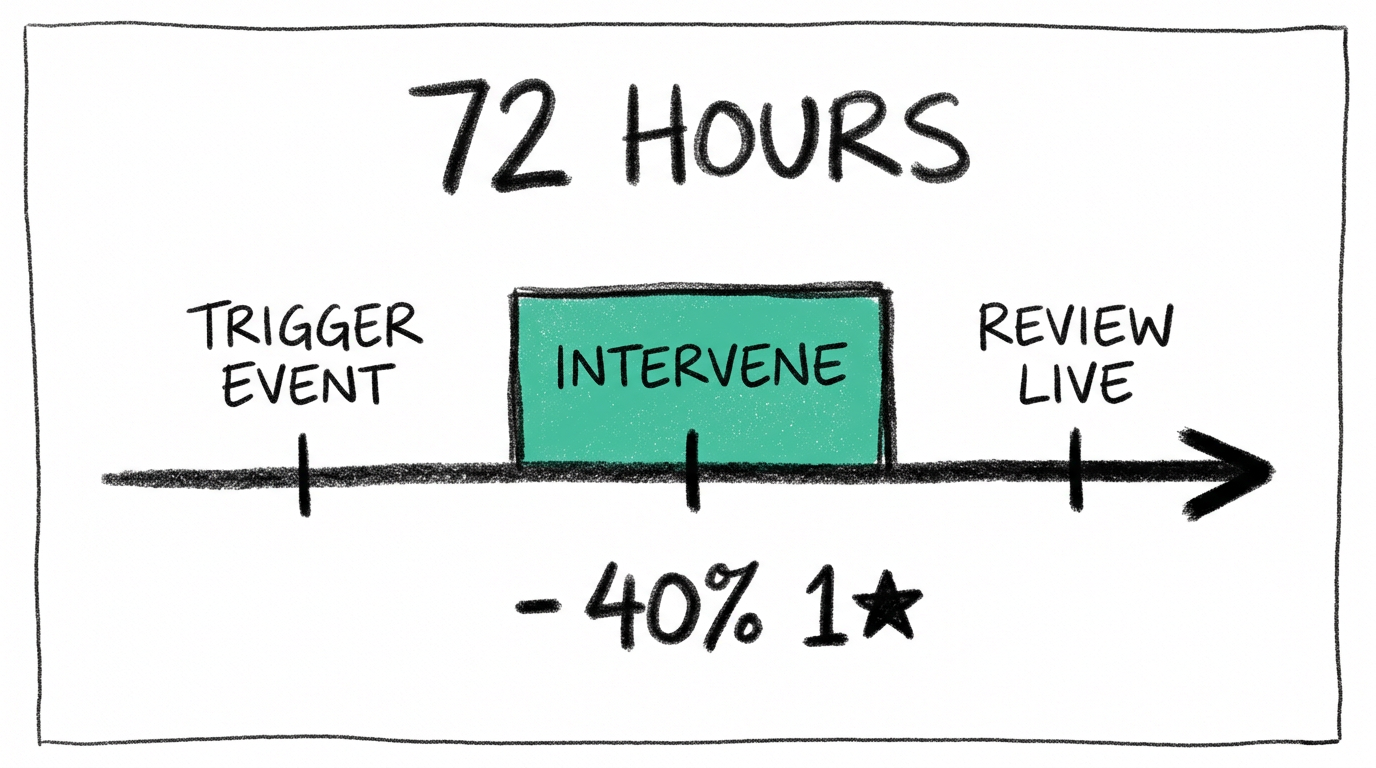
Between the triggering event — a lost parcel, a poor support response, a defective product — and the published review, an average of 72 hours passes.
The critical zone is shorter: the first 24 hours. That's when intervention is most effective. After that window, the customer has often already composed their review mentally, sometimes literally.
Interventions triggered within 6 hours of an alert signal reach an 87% resolution rate. After 24 hours, that rate drops to 62%.
A customer whose problem is resolved before frustration turns to resentment has no reason to post a 1-star review.
Activate preventive mediation
Detect at-risk customers before they post.
- Real-time customer risk score
- Alerts in Gorgias, Zendesk, or Slack
- -40% 1-star reviews in 90 days
How Review Collect detects and routes mediation alerts
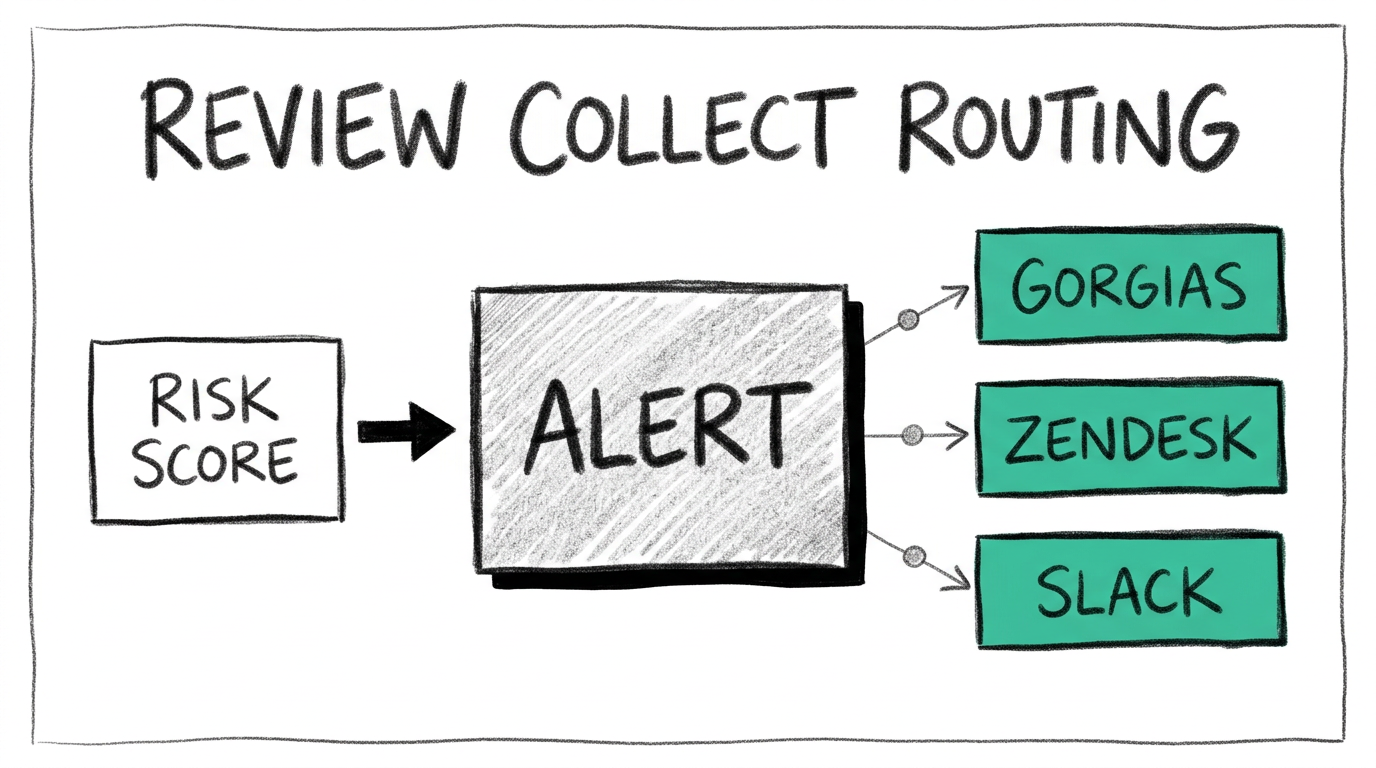
Review Collect continuously calculates a risk score per customer from three data sources.
NPS/CSAT data. Responses to your satisfaction surveys are synced in real time.
Support data. The status of your open tickets via Gorgias, Zendesk, Crisp, or your current support tool.
Logistics data. Delivery delays from your e-commerce platform (Shopify, WooCommerce, PrestaShop).
When a customer crosses a risk threshold you define, an alert is sent to the right agent according to your routing rules. The agent sees the full context: order concerned, customer history, likely reason for dissatisfaction.
Standard workflow: the agent receives the alert in their usual tools, contacts the customer proactively (email, SMS, or WhatsApp), resolves the issue, then invites the customer to share their experience if they're satisfied.
That's where the loop closes. A customer whose problem was resolved is often more engaged than one who never had any friction. They have a story to tell.
Results: -40% 1-star reviews with active mediation
Review Collect customers who activate preventive mediation see an average 40% drop in 1-star reviews within 90 days of activation.
The reason: most 1-star reviews don't punish a bad product. They punish poor problem management. A poorly handled delivery delay. A refund that takes too long. A cold or off-topic support response.
Preventive mediation doesn't make problems disappear. It changes how they end.
For negative reviews that do get published, a well-crafted response remains your best tool. The guide how to respond to a negative review covers the method.
For teams looking to respond to every published review quickly, Review Collect's review response feature generates a tailored reply in under 60 seconds.
Preventive mediation and compliance: what you need to know
One question comes up regularly from legal teams: is this review gating?
No. The distinction comes down to one precise point. Review gating conditions access to review platforms based on customer satisfaction, and it's that conditionality that's banned. Preventive mediation conditions nothing: it applies to all customers showing dissatisfaction signals, regardless of what they intend to publish. The customer always has the final choice — contact support, post a review, or both.
| Criterion | Review gating | Preventive mediation |
|---|---|---|
| Principle | Filters access to review platforms based on declared satisfaction | Offers a private resolution alternative |
| Legality | Banned (Trustpilot, Google, EU Omnibus Directive) | Compliant with industry best practices |
| Customer choice | Restricted based on declared satisfaction | Free at all times |
| Measured result | Legal risk + artificial bias on your rating | -40% 1-star reviews, 93% choose support |
The guiding principle: offer an alternative, not create a barrier.
How Review Collect integrates with your existing customer service
Preventive mediation works with your current support stack. Review Collect sends alerts directly into the tools your team already uses: Gorgias, Zendesk, Crisp, Slack, or email.
Your team has nothing new to learn. Alerts look like standard support tickets, with added customer context.
Initial setup takes under an hour. You define your alert thresholds, routing rules, and a default intervention message. After that, the system runs autonomously. Your team steps in for the right customers, at the right moment, without added workload.
Frequently Asked Questions
Analyze with AI
Ask your questions about "Preventive Mediation for Customer Reviews: Stop Negative Reviews Before They're Posted" with your preferred AI
Growth Hacker