
Customer Reviews for Real Estate Agencies: The Guide to Winning More Listings
93% of consumers read reviews before making a decision. In real estate, reviews don't just build trust — they determine who wins the listings.
 Victor· Growth Hacker
Contents
- Why reviews have become the #1 tool for winning listings
- The 4 key moments to request a review in a real estate transaction
- Google, Immodvisor, SeLoger: which platform generates the most leads?
- How to respond to negative reviews specific to real estate
- Networks and franchises: consistent reputation across 10, 50, 200 agencies
- How Review Collect automates review collection for agencies
TL;DR
- →58% of buyers trust an agency more when it responds to its reviews, including negative ones.
- →Request reviews at 4 distinct moments: post-viewing, post-offer, post-agreement, post-key handover.
- →Prioritize Google and Immodvisor: the two platforms where sellers search for their agency.
- →Real estate networks must centralize collection to avoid rating gaps between agencies.
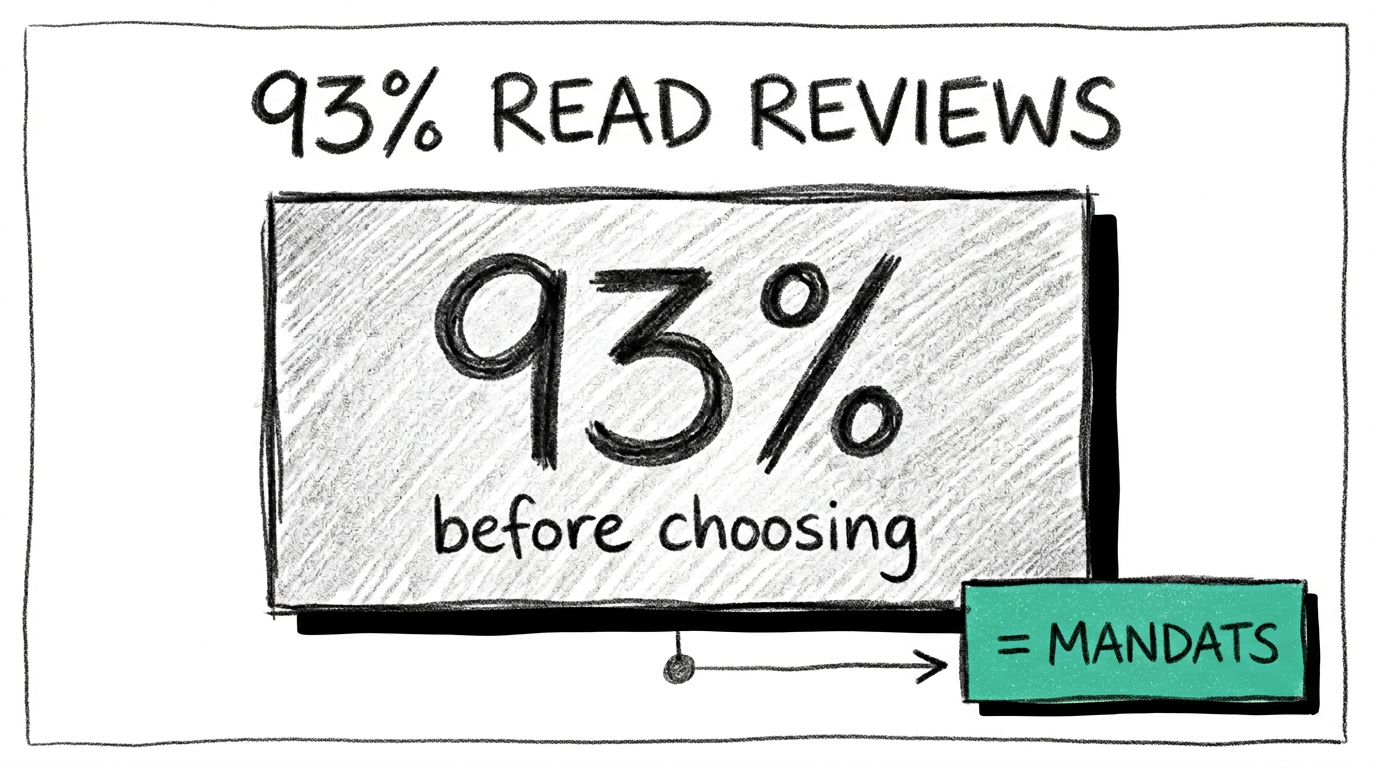
According to an Ifop 2026 study, 93% of consumers read reviews before making a decision. In real estate, that decision involves hundreds of thousands of euros. This figure probably underestimates the sector.
This guide explains how to turn your client reviews into a listings pipeline — when to ask, where to publish, and how to handle reviews when a transaction goes wrong.
Why reviews have become the #1 tool for winning listings
A seller looking for an agency isn't looking for the "best" agency in the abstract. They're looking for someone they can trust with the most valuable asset they own. Client reviews are the most direct trust signal available to them.
And they don't just read the rating. They read the responses. A prospective seller who sees an agency reply to every review, including the negative ones, calmly and with precision, learns more about the team's professionalism than from ten storefront photos.
58% of buyers trust a business more when it responds to its reviews (Ifop, 2026). For a real estate agency, every published response is sales copy read by hundreds of prospective sellers comparing agencies.
In a sector where agencies often compete on the same arguments (exclusive mandate, free valuation, negotiable fees), reviews are frequently the only visible differentiator before the first contact. 54% of consumers are willing to pay more for a well-rated business with a high volume of reviews.
Improving your Google rating isn't a reputation management exercise. It's a listings volume question.
The 4 key moments to request a review in a real estate transaction
Most agencies wait until key handover to ask for a review. It's the most logical moment, but also the latest. A real estate transaction generates four distinct emotional moments, each producing a different type of review.
| Moment | Trigger | Recommended channel | Type of review obtained |
|---|---|---|---|
| Post-first visit | 24h after the visit | SMS or WhatsApp | Quality of welcome and presentation |
| Post-accepted offer | 48h after acceptance | Negotiation effectiveness | |
| Post-sale agreement | 24h after signing | Administrative support | |
| Post-key handover | Day of handover | SMS | Overall experience and recommendation |
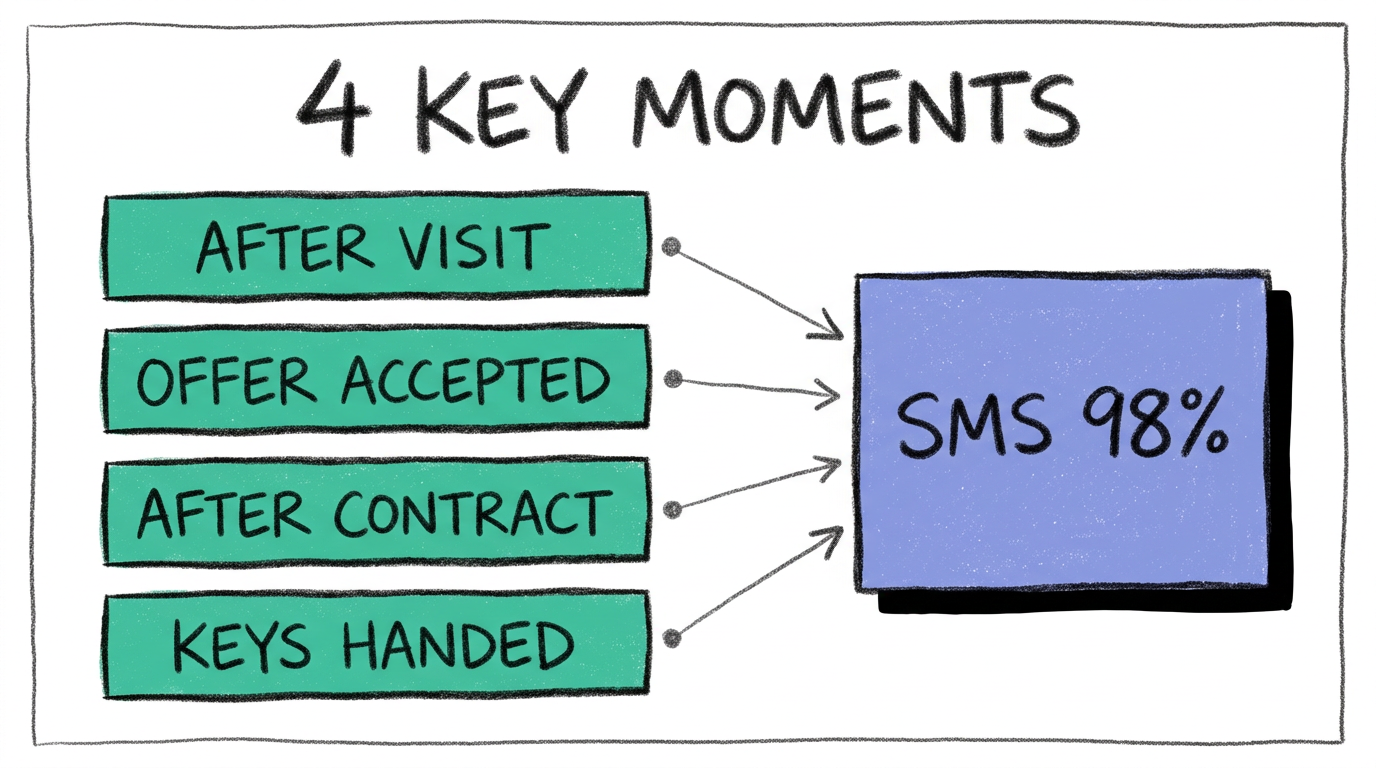
Waiting for key handover means missing three opportunities. A satisfied buyer right after a viewing leaves a review with detail and enthusiasm they won't have six weeks later.
SMS and WhatsApp requests achieve 98% open rates versus 20% for email. In real estate transactions where the relationship is already personal, SMS fits naturally into existing exchanges.
Google, Immodvisor, SeLoger: which platform generates the most leads?
Not all review platforms are equal for a real estate agency. The question isn't just "where are my reviews?", but "who reads them, and with what intent?"
| Platform | Primary audience | Listing impact | Priority |
|---|---|---|---|
| Buyers AND sellers, strong local intent | High (Maps + local SERP) | Priority 1 | |
| Immodvisor | Owners comparing agencies | Very high (direct listing intent) | Priority 1 |
| SeLoger | Buyers and renters | Medium (indirect brand awareness) | Priority 2 |
| Pages Jaunes | Generic search | Low | Priority 3 |
| PAP | Private sellers bypassing agencies | Negligible | - |
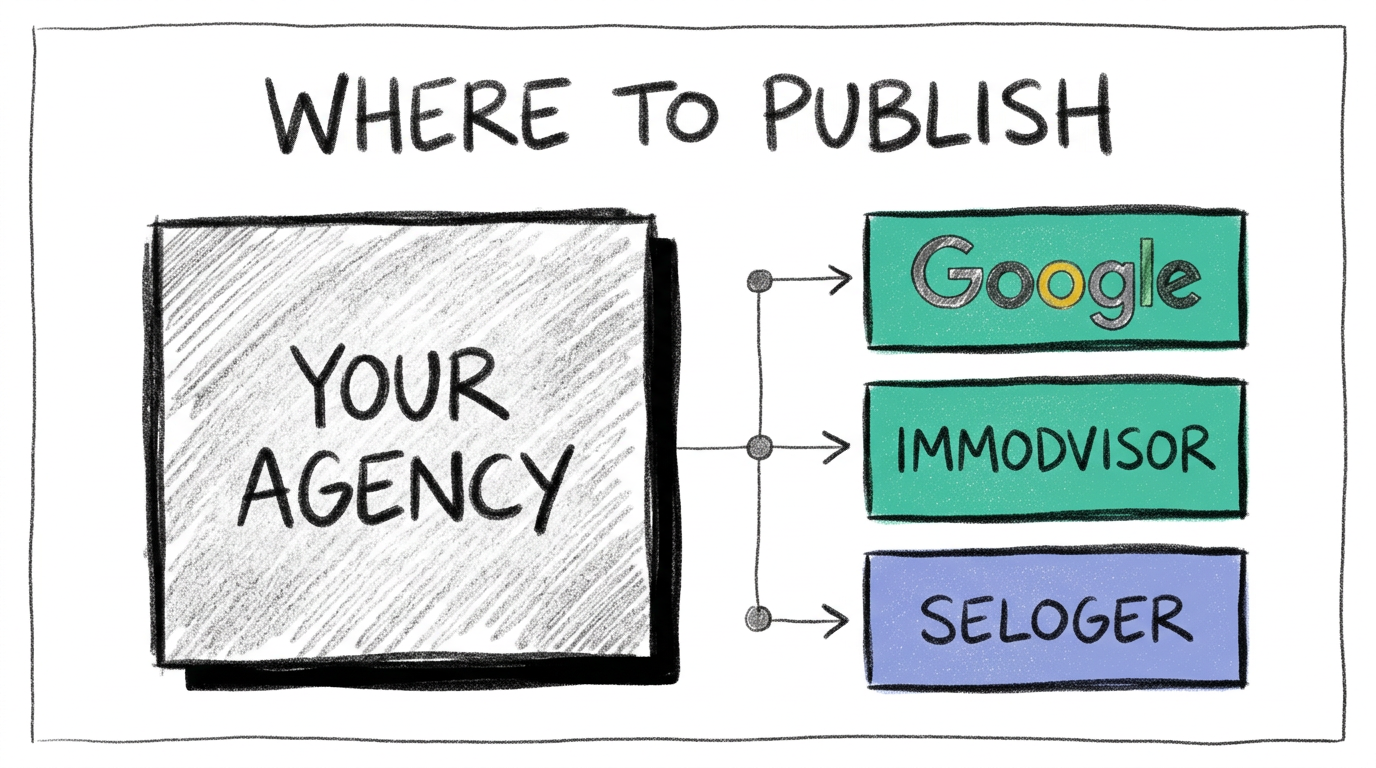
Google first. An agency's Google Business Profile appears on every local search for "real estate agency [city]". A high rating with recent reviews drives calls directly. Without recent reviews, the profile disappears behind competitors who have them.
Immodvisor second. This is the platform sellers consult when actively comparing agencies before choosing who to trust with their mandate. The audience is smaller, but the intent is exactly what you need.
Centralize your Google, Immodvisor and SeLoger reviews
Review Collect automatically distributes your review requests across the platforms that matter for your agency.
- Real estate CRM connection in 48h
- Automatic post-transaction collection
- Real-time multi-agency dashboard
How to respond to negative reviews specific to real estate
Real estate generates emotionally charged negative reviews. A failed sale, a disputed valuation, a rejected offer: the disappointment is proportional to the financial stakes. Three situations come up consistently.
"Failed sale" review: "Your agency wasted 4 months of my time for nothing." Response: "Your frustration is understandable. This sale ran into difficulties because of [specific factual element]. We [concrete action taken]. Contact us directly and we'll walk you through every step we took."
"Overvalued estimate" review: "The valuation was £350,000. The property sold for £290,000." Response: "The March 2025 valuation reflected a market that was still rising. We had flagged this volatility to you. The property ultimately sold within a reasonable timeframe given local market conditions at the time."
"No communication" review: "We never heard anything." Response: "This is feedback we take seriously. We've strengthened our follow-up process since then. Can you get in touch directly so we can reconnect?"
The rule in every case: stay factual, name the problem, give a concrete explanation, offer a next step. A prospective seller reading that response knows the agency handles difficult situations rather than avoiding them.
Read our full guide on responding to negative reviews for the complete method.
Clients who receive a response to their review are twice as likely to contact the agency again for a future transaction.
Networks and franchises: consistent reputation across 10, 50, 200 agencies
Real estate networks (Orpi, Century21, IAD, Laforêt) face a problem independent agencies don't: the disconnect between the national brand rating and each local agency's rating.
A property owner in Lyon searching "Orpi Lyon 3" sees the local agency's Google profile, not the network's national rating. If that agency has 3.2/5 because it hasn't collected reviews in two years, that's the rating that appears, regardless of the network's overall reputation.
Rating inequality. Gaps of 1.5 stars between two agencies from the same network in the same city are common. They destroy brand consistency.
Stale reviews. An agency with 20 reviews from 2022 and nothing since loses visibility even if the reviews are positive. Google prioritizes review recency in its local algorithm.
Inconsistent responses. A franchisee who doesn't respond to reviews damages the network's image without headquarters even knowing.
Review Collect provides a multi-agency dashboard built for this type of structure: global view with per-agency drill-down, rating drop alerts, and network reporting exports.
For networks managing multiple locations, our complete guide on franchise and multi-location review management covers governance models and the tools to manage reputation across 10 to 200 agencies.
Multi-office real estate agencies share the same challenges as other franchises: read our guide on multi-location management. And to turn satisfied clients into long-term ambassadors, customer loyalty through reviews remains an underused lever in real estate.
How Review Collect automates review collection for agencies
The main obstacle to review collection in real estate isn't a lack of satisfied clients. It's the lack of process.
A negotiator who just signed a purchase agreement doesn't think about sending a review request. They move on to the next viewing. Without automation, collection depends on each team member's memory and stays sporadic.
Review Collect connects to real estate CRMs (Hektor, Perizia, Adaptimmo) and automatically sends a review request at the right moment, on the right channel, in the right format. Agencies using it multiply their reviews by 30 in 30 days, with a response rate of up to 39%.
The typical post-transaction sequence:
- Day 0 post-viewing: automatic SMS
- Day 1 post-agreement: personalized WhatsApp
- Day 3 post-completion: email with direct link to Google or Immodvisor
The agency chooses the target platforms. Review Collect handles the distribution.
Frequently Asked Questions
Analyze with AI
Ask your questions about "Customer Reviews for Real Estate Agencies: The Guide to Winning More Listings" with your preferred AI

Growth Hacker