
Franchise Review Management: The Complete Guide for Multi-Location Networks
One 3.2-star Google listing in your network cancels out your 4.5-star locations. The issue isn't franchisee motivation — it's the absence of a centralized system.
 Victor· Growth Hacker
Contents
- Why a network's reputation is decided location by location
- The 3 causes of rating gaps between locations in the same network
- How to audit 10, 50 or 200 locations in 20 minutes
- Who collects reviews in a network: franchisor, franchisee, or both?
- Responding to reviews at scale: charter, delegation and automation
- How Review Collect manages multi-location network reputation
TL;DR
- →Google ranks each location independently — a 3.2-star listing in your network cancels out your 4.5-star ones.
- →The 3 causes of rating gaps: stale reviews, no responses, no systematic collection process.
- →The hybrid model (HQ drives collection + shared response charter) generates 3x more reviews than decentralized management.
- →A centralized dashboard lets you audit 200 locations in 20 minutes and catch underperforming listings before they hurt results.
In a franchise network, Google's algorithm doesn't know your national brand. It ranks each listing separately. A chain with 80 locations can display ratings from 3.1 to 4.8 in the same city. That's not an edge case — it's the reality for most networks without a centralized review process.
This guide explains why rating gaps happen, how to audit them fast, and how to fix them without relying on each franchisee's motivation.
Why a network's reputation is decided location by location
A consumer searching "pharmacy downtown Lyon" gets the Google listing for Pharmacy Pasteur — not your national chain rating. If that listing shows 3.2 stars and 8 reviews, that's what they see, regardless of your network's overall reputation.
Google Maps ranks local results on three criteria: relevance, distance, and prominence (recent reviews, volume, responses). Your national brand rating doesn't factor in.
The result: every location is solely responsible for its own position in local results. A franchisee who hasn't collected reviews in two years loses visibility, even with excellent service. They can drop behind an independent competitor who automated their collection.
For a network, online reputation isn't a brand asset. It's an aggregate of 80, 200 or 500 local situations — all changing without HQ knowing.
The 3 causes of rating gaps between locations in the same network
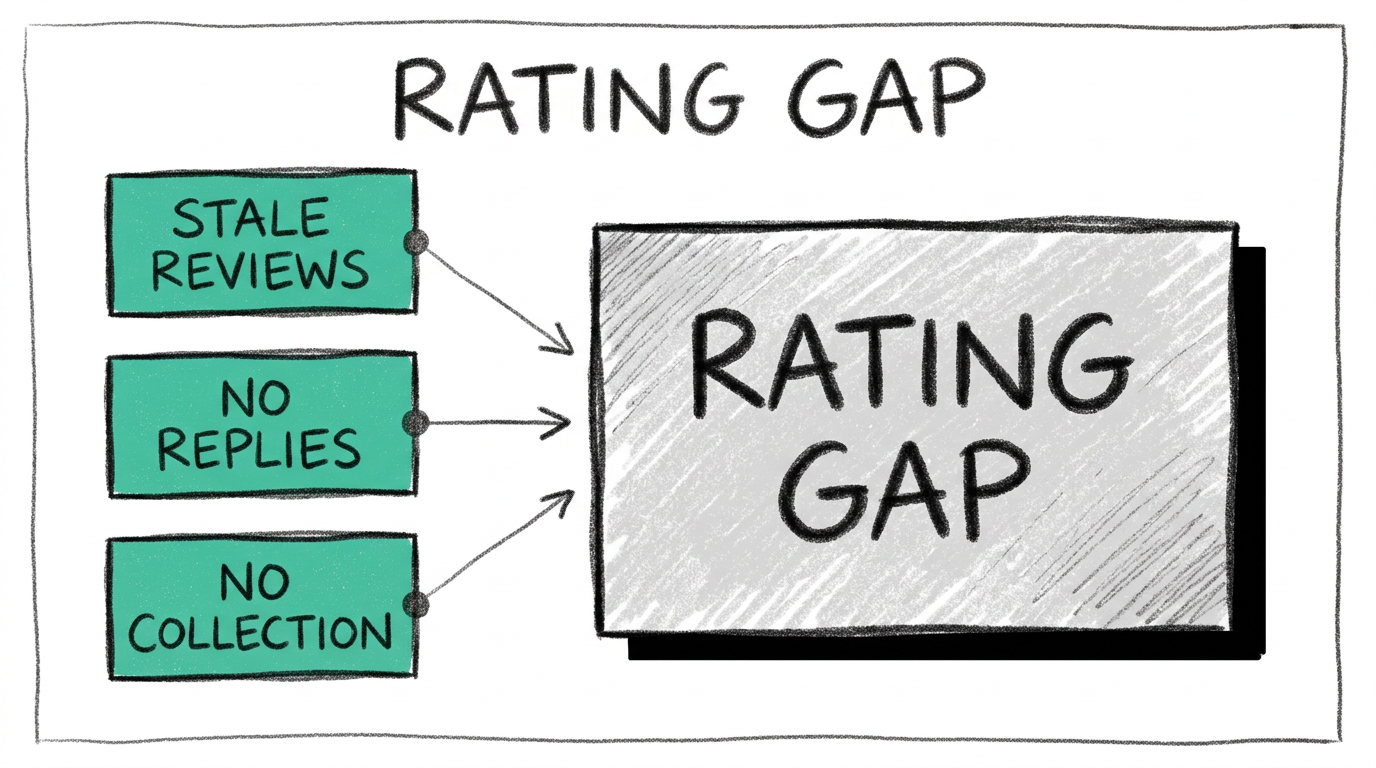
In most networks, rating gaps aren't caused by actual service quality differences. They come from three structural problems.
| Cause | Detectable signal | Impact on visibility |
|---|---|---|
| Stale reviews (last review > 6 months ago) | Google listing with no recent activity | Drop in Maps rankings, declining impressions |
| No responses to reviews | 0 owner responses on the last 12 reviews | Visible loss of trust, lower perceived rating |
| No systematic collection | Fewer than 10 reviews in 12 months for an average-traffic location | Frozen rating, competitors who collect keep climbing |
Stale reviews. Google prioritizes recency in its local algorithm. A location with 40 positive reviews but the last one dating 14 months back loses ground to a competitor with 12 recent reviews. In many networks, some locations collected heavily in 2022 and nothing since. Their rating looks fine — but their visibility is declining.
No responses. 58% of consumers trust a business more when it responds to reviews (Ifop, 2026). In decentralized networks, franchisees don't all respond with the same consistency. A prospective customer comparing two nearby locations of the same brand sees the difference immediately.
No systematic collection. The most common problem. A location manager happy with their service doesn't think to ask for a review after every transaction. Without automation, collection depends on individual memory — and stays sporadic.
How to audit 10, 50 or 200 locations in 20 minutes
A manual reputation audit for 50 locations takes a full day. Opening each Google listing, noting the rating, counting recent reviews, checking responses. It doesn't scale — and produces no real-time alerts.
A centralized dashboard replaces that work with three views:
Network overview. Average rating by network and distribution of locations by tier (below 3.5, 3.5–4.0, 4.0–4.5, above 4.5). In 30 seconds, you see how many locations are below the threshold that triggers contact loss.
Per-location view. Drill-down on each listing: current rating, review volume over 30, 90 and 365 days, response rate, date of last review received. Locations that haven't collected in 3 months stand out immediately.
Proactive alerts. Any rating drop above a defined threshold triggers a notification. HQ knows there's a problem before it impacts that location's commercial results.
Manage your entire network's reputation from one dashboard
Review Collect centralizes reviews across all your locations, flags underperforming listings, and automates collection without manual effort.
- Live consolidated view of every location
- Automatic alerts on rating drops
- Automated collection from your CRM or POS
Who collects reviews in a network: franchisor, franchisee, or both?
Both models work. But not with the same tools or governance.
| Model | Description | Advantages | Risks |
|---|---|---|---|
| Centralized | HQ triggers requests, manages response templates | Brand consistency, no dependency on franchisees | Requires CRM/POS integration per location |
| Decentralized | Each franchisee manages their own account and requests | Local proximity, fast response | Inconsistency, inactive franchisees go undetected |
| Hybrid | HQ drives collection, franchisee handles responses locally | Volume + local authenticity | Setup coordination required at launch |
For most networks with more than 20 locations, the hybrid model delivers the best results. HQ automates collection via a platform connected to the CRM or POS. Local teams manage responses using validated templates.
What most networks overlook: a response charter. Without clear guidelines on tone, timeframes and typical situations, responses vary from one location to the next and blur the brand image.
Networks that centralize collection and delegate responses with a charter collect 3x more reviews on average than those that leave each franchisee to manage alone.
Responding to reviews at scale: charter, delegation and automation
A network of 50 locations can receive dozens of reviews per day. Responding to each one manually isn't sustainable without structure.
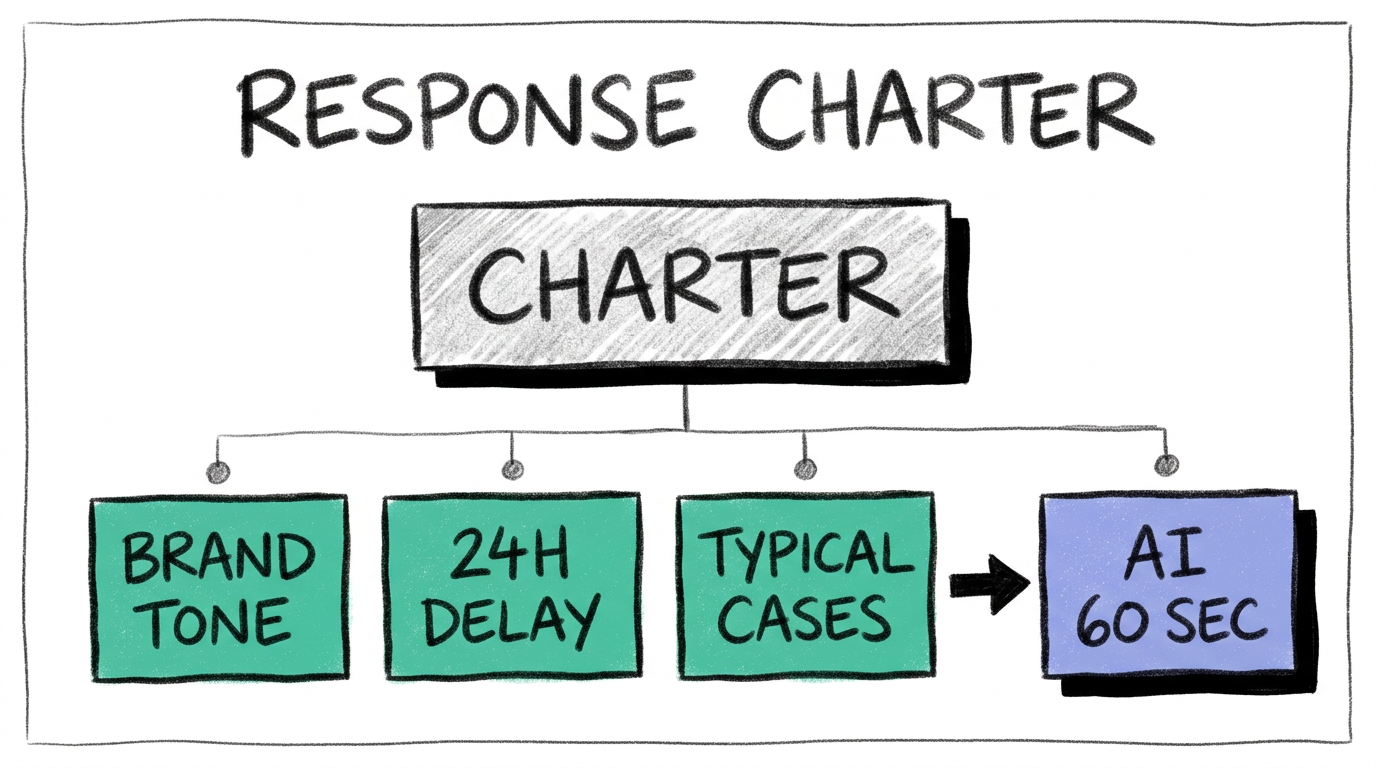
Three tools make responses work at scale:
The response charter. A short document — two pages maximum — that defines brand tone, target timeframes (24h for a negative review, 72h for a positive one), and response templates for the 5 most common situations. Each franchisee gets a template to personalize, not a rigid script.
Tiered delegation. Positive reviews are handled by local teams using the templates. Negative reviews below a defined threshold (1 or 2 stars) escalate to HQ for a coordinated response.
AI for the first draft. A response generated in under 60 seconds gives the local team a solid starting point to personalize in a few words. For teams unaccustomed to responding, it eliminates the blank-page block and cuts handling time by 3 to 5x.
For complex negative reviews, our guide on responding to negative reviews covers the method in detail — the principles apply equally to franchise teams.
Each sector has its own specificities when it comes to network review management. Real estate agencies are a textbook case with their dozens of local listings. To see how an e-commerce network structures its review strategy, read our Axome case study.
How Review Collect manages multi-location network reputation
The problem with franchise networks isn't a shortage of satisfied customers. It's the lack of a system to reach them at the right moment.
Review Collect connects to the network's CRM or POS and automatically triggers review requests after each transaction. Networks using it multiply their reviews by 30 in 30 days, with a collection rate of up to 39%.
For multi-location networks, the platform adds three specific capabilities:
- A consolidated dashboard showing each location's rating and review volume in real time
- Configurable alerts for rating drops or collection gaps
- AI response management per location, with customizable brand tone per franchise
HQ drives, franchisees benefit. See the multi-location network solution.
Gym chains face unique multi-location review challenges. See our guide to customer reviews for gyms for fitness-specific strategies.
Frequently Asked Questions
Analyze with AI
Ask your questions about "Franchise Review Management: The Complete Guide for Multi-Location Networks" with your preferred AI

Growth Hacker