Which Review Platforms Do AI Assistants Actually Cite?
AI assistants cite brand sites, listings, forums and review sites, and the studies do not agree on the split. What you can control is how consistent your reviews look on every platform.
 Victor· Growth Hacker
Contents
- Which sources do AI assistants use to describe a brand?
- Do reviews actually drive AI answers, or just go along with them?
- Why do ChatGPT, Perplexity and Google AI Mode cite different sources?
- What does a multichannel brand have to keep consistent across platforms?
- How do you handle reviews on several platforms without a spreadsheet?
- How should you route happy customers to the right platform?
- Should you reply to reviews everywhere?
- How do you check what AI says about your brand?
- How does Review Collect centralize review management?
TL;DR
- →AI assistants cite a mix of brand sites, listings, forums and review sites, and the mix differs from one assistant to another. No study proves that a given platform gets a brand recommended.
- →You cannot control which sources an assistant reads. You can control whether your rating, your review volume and your replies tell the same story on every platform.
- →Do three things this week: list your platforms, compare rating and reply gaps between them, and set one routing rule for happy customers.
AI assistants cite a mix of brand sites, listings, forums and review sites, and that mix changes from one assistant to the next. So AI reputation management, meaning keeping track of what AI assistants say about your brand and where they get it, starts with the part you can control: making sure every source an assistant might read tells the same story about your brand.
Which sources do AI assistants use to describe a brand?
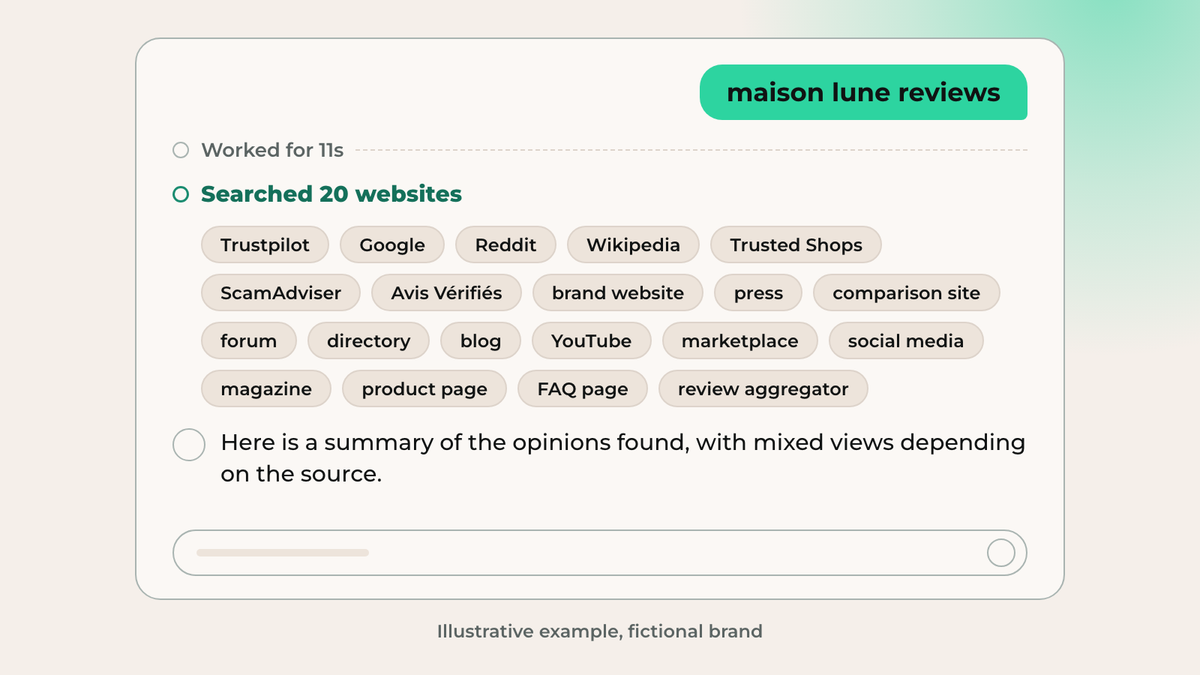
They draw on your own website, business listings, review sites, forums and editorial pages, and the share of each depends on who measured it. Yext analyzed 6.8 million citations from Gemini, OpenAI and Perplexity and published the split in October 2025: brand websites 44%, listings 42%, reviews and social 8%, and forums like Reddit about 2%.
Read that with care. Yext sells listings and brand-presence software, so it has a reason to stress sources a brand manages. Its "86% brand-managed" headline also rests on a broad definition of the term. The numbers are real, the framing a vendor's.
For the wider work of making your brand findable in AI answers (GEO), see the GEO, AEO and SEO page. Here we only look at review platforms, which are one source among several: 8% of citations in Yext's split, 14.01% in Seer's data below. Every study picks its own sample, assistants and definitions, so when two numbers disagree, check the definition first. A "review" is a review site in one report and reviews and social grouped together in another.
Do reviews actually drive AI answers, or just go along with them?
Reviews go along with AI answers, and no study shows that they drive them. The most detailed data comes from Seer Interactive, which analyzed 804,491 AI responses about 1,926 brands across ChatGPT, Google AI Mode, Gemini and Perplexity, using data mostly from March 2026. It found that review and trust sites are the second-highest citation source in AI responses, and that review profiles correlate with higher citation rates.
That does not contradict Yext's 8%. Seer counts review and trust sites as one category and Yext counts reviews and social together, with different methods, so the two figures are not comparable. Yext's four shares (44%, 42%, 8% and 2%) also do not add up to 100% in its presentation, and we do not guess what fills the rest.
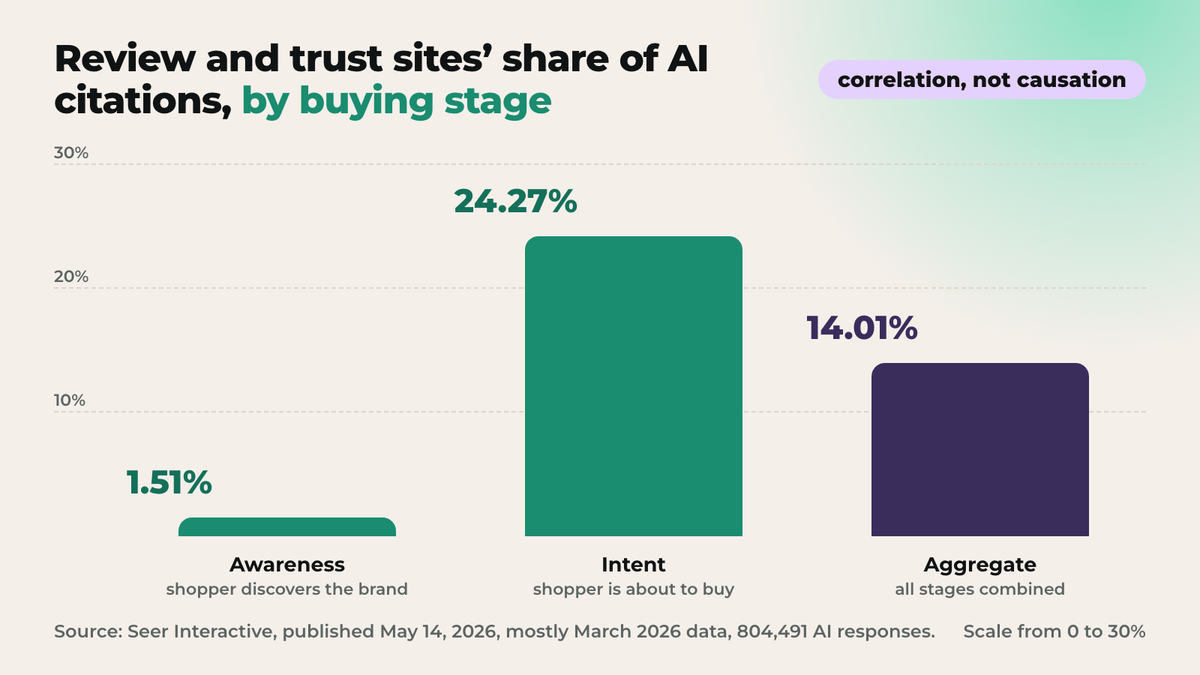
Seer splits citations by buying stage: awareness means the shopper is just discovering the brand, and intent means the shopper is about to buy. Its authors admit that marketing spend and audience size may explain some of the gap. The table sets every study we opened side by side.
| Study | Date | Sample | What it measures | Correlation or demonstrated |
|---|---|---|---|---|
| Seer Interactive | May 14, 2026 (March 2026 data) | 804,491 responses, 1,926 brands, 4 assistants | Review and trust sites' share of citations: 1.51% at awareness, 24.27% at intent, 14.01% overall | Correlation. Authors note spend and audience size may play a part |
| Yext | Oct 9, 2025 | 6.8M citations, Gemini, OpenAI, Perplexity | Share of citations by source type | Descriptive. Vendor study, broad "brand-managed" definition |
| Profound | Jun 5, 2025 (updated Aug 2025) | 680M citations, Aug 2024 to Jun 2025 | Source share by assistant | Descriptive. Vendor study |
| 5W Public Relations | May 11, 2026 | About 600,000 US ChatGPT citation events (Similarweb), Jan to Feb 2026, inside a synthesis of nine studies | Share of ChatGPT citations by domain | Descriptive. Synthesis by a PR firm that sells GEO services |
| Promptwatch, reported by Semrush | Aug 26, 2026 | Sample not given | Reddit's share of ChatGPT citations, 3.8% then 0.5% | Descriptive. Authors call the drop provisional |
Review and trust sites account for 14.01% of all citations in Seer Interactive's sample (published May 14, 2026, data from March 2026, correlation only).
What does the stage split tell you?
It tells you reviews show up most when a shopper is close to a decision. Review sites made up 1.51% of citations at the awareness stage and 24.27% at the intent stage. The 14.01% is the share across all stages combined, which is why it sits below 24.27%. Intent fits shopping behavior: people read strangers' opinions once they have a shortlist.
But the split describes which sources appear, not which brand gets picked. So the intent-stage figure is a reason to keep your reviews healthy, not a lever you can pull.
Where does this leave the Trustpilot question?
Whether a Trustpilot profile makes assistants cite you is not proven. We analyzed it in detail in our Trustpilot analysis, which finds that review platforms make up a small share of AI citations. This article widens the view to all your platforms, because the risk is the gaps between them: an assistant reading several platforms can find different ratings and give different answers.
Why do ChatGPT, Perplexity and Google AI Mode cite different sources?
Each assistant builds its answers from its own mix of sources, and the measured shares differ a lot. Profound analyzed 680 million citations from August 2024 to June 2025 and published the shares by assistant. Reddit accounted for 1.8% of ChatGPT citations, 2.2% of Google AI Overviews citations and 6.6% of Perplexity citations. Wikipedia took 7.8% of ChatGPT citations but only 0.6% of AI Overviews citations.
So the same question can lead to different sources depending on the assistant, and you cannot know which assistant your buyer asks.
Why do the Reddit numbers contradict each other?
They contradict each other because the studies measure different things at different times. We list them without picking a winner:
- Yext: forums like Reddit, about 2% of citations (Gemini, OpenAI, Perplexity)
- Profound: Reddit, 1.8% of ChatGPT citations, 6.6% of Perplexity citations (August 2024 to June 2025)
- Promptwatch: Reddit, 3.8% of ChatGPT citations, then 0.5% (reported August 2026, provisional)
- 5W Public Relations, using Similarweb data: Reddit, 11.97% of US ChatGPT citations (January to February 2026)
Different dates, different samples and different definitions probably explain part of the spread, though none of the studies verifies that. One more trap: the 46.7% Reddit figure for Perplexity that circulates online is a share of Perplexity's top 10 sources, not of all its citations.
What should you take from the gap?
The source mix moves, and it moves fast. A Reddit share falling from 3.8% to 0.5% shows how quickly an assistant can change what it reads. You can't plan around that, but you can make sure an assistant finds a consistent picture wherever it looks.
What does a multichannel brand have to keep consistent across platforms?
Keep three things aligned on every platform: your rating, your review volume and recency, and how you reply. These are the signals a shopper, or an assistant summarizing a shopper's view, can compare in seconds. If your Google rating says 4.8 and your Trustpilot profile says 3.9, whichever one gets read tells a different story.
A gap like that often comes from collection, not product quality, so the fix is operational.
What should match from one platform to the next?
- Rating and count: a similar average, and enough reviews that the average means something
- Recency: recent reviews on every platform, not one active profile and three dormant ones
- Replies: the same tone, the same speed and the same policy for negative reviews
- Facts: opening hours, shipping terms and product details identical on every listing and page
What is the risk of depending on one platform?
You bet on a source the assistants may stop reading. The Reddit swings above show how fast a source's weight can change, so spreading reviews across two platforms is not redundancy. It's insurance against a shift you cannot predict.
How does this change by sales channel?
It changes with where your buyers read:
- Direct-to-consumer site: Google and one third-party platform, plus reviews on your own product pages
- Marketplaces: reviews live on the marketplace and you can't move them, so your rating there should not drift away from your own sites
- B2B software: G2 and Capterra matter beside Google, because buyers compare there
- Physical stores: Google listings carry most of the weight, so reviews and replies there come first
How do you handle reviews on several platforms without a spreadsheet?
You handle them in one dashboard that pulls every platform's rating, review count and unanswered reviews into a single view. The alternative is the spreadsheet most teams build, updated by hand when someone remembers. It goes stale within a week, hides unanswered reviews because they live on the platform, and says nothing about gaps until somebody does the math.
A dashboard means you stop copying numbers and start looking at gaps. Then you act on them, sending the next happy customers to the platform that is behind and answering the reviews still waiting.

How should you route happy customers to the right platform?
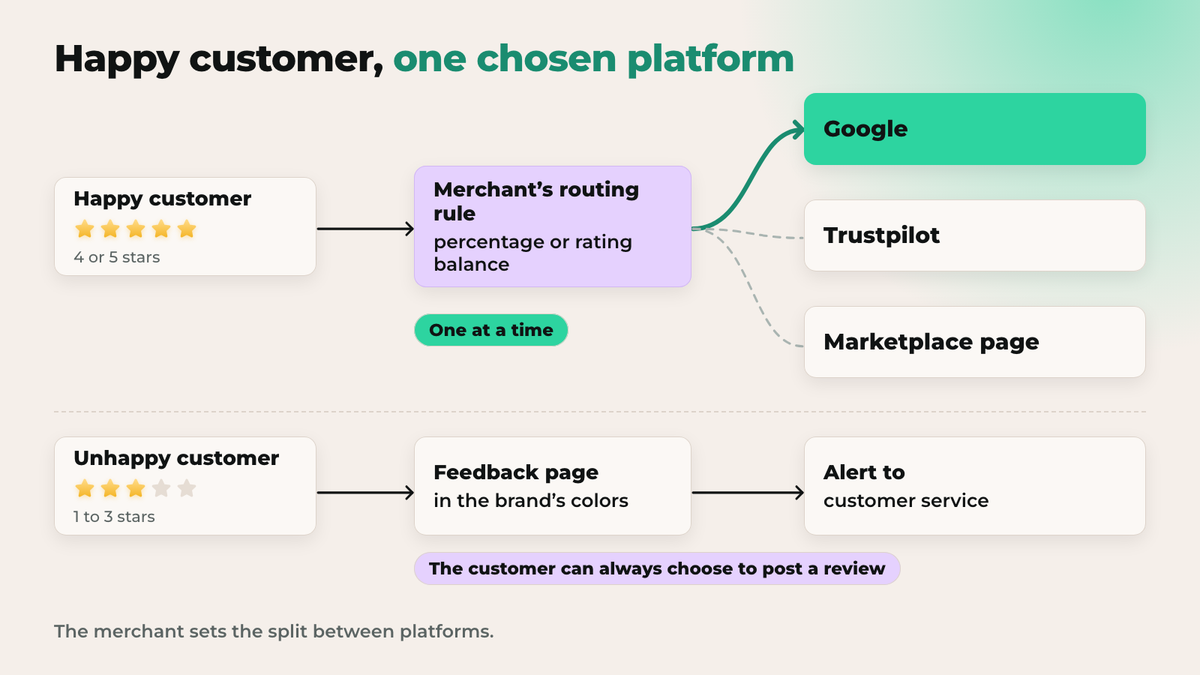
Send each happy customer to one platform, chosen by a rule you set once. That is routing: with Review Collect, each satisfied customer (4 or 5 stars) goes to one platform at a time, following the rule you set, never to several at once. You configure the destination yourself, by percentage or by rating balance.
Which routing rule should you pick?
Pick the rule that matches your gap. Two common ones:
- By percentage: 60% of happy customers go to Google and 40% to your second platform. You get a steady flow to both.
- By rating balance: the next happy customers go to the platform where your rating is lowest. This closes a gap faster than a fixed split.
Start with balance if your gap is large. For the detailed setup, see our guide on how to distribute customer reviews across multiple platforms.
What happens to customers who are not happy?
What about customers who are not satisfied? They go to a branded feedback page instead, a page in your brand's colors where they explain the problem. Meanwhile your customer service team gets an alert with the feedback text, the order number and the customer's contact details. Your team can call back and fix the problem. The customer still keeps the choice to publish a review. So the route is a support path, not a way to manage your score.
Should you reply to reviews everywhere?
Yes, reply on every platform where you collect reviews, positive and negative, in the same brand voice. The reason is consistency. A shopper who sees thoughtful replies on Google and silence on Trustpilot concludes that one profile is looked after and the other is abandoned.
No study shows that replying changes what an assistant says about you, so don't sell it internally as an AI tactic. It's a brand-consistency and customer-care habit.
Can you do this at scale?
You can if the replies are automated and kept in your tone. Review Collect writes an AI reply to every published review on the connected platforms, positive and negative, in your brand's tone. For risky reviews, such as a legal threat or a safety claim, the tool alerts a human instead, so a person decides how to answer.
What about Reddit and forums?
Treat them as sources to watch, not platforms to manage. You can't route customers to Reddit and you shouldn't try. But a thread that mentions your brand can show up in an AI answer, so someone on your team should read it and join in by hand when useful.
How do you check what AI says about your brand?
Check it in two layers: the platforms an assistant can read, and the assistants themselves. The table covers the first layer, with the role of each platform, what to track and what to do.
| Platform | Role | What to track | Action |
|---|---|---|---|
| Google Business Profile | Listing that shoppers and assistants can both read | Rating, review count, latest review date, unanswered reviews | Reply to everything and keep facts current |
| Trustpilot or another third-party platform | Independent review profile | Rating gap against Google, recency of reviews | Route happy customers here when it lags |
| G2 and Capterra (B2B) | Where software buyers compare | Rating, volume and recent reviews per product | Keep them in the routing rule if you sell B2B |
| Marketplaces | Reviews you do not control | Rating compared with your own sites | Fix the cause of any gap at the source |
| Your product pages | Reviews on your own domain | Whether the displayed rating matches the platforms | Syndicate the same reviews, not a different set |
| Reddit and forums | Sources to monitor only | Threads that mention your brand | Read them, reply by hand when it helps |
The platforms are one layer; what assistants say about you is the other. Our page on AI Perception covers it: it queries five assistants (ChatGPT, Claude, Gemini, Mistral and Perplexity), gives a global score out of 100 and a verdict per assistant, lists the grievances it finds, proposes an action plan and benchmarks you against four competitors. For a broader read on what an assistant says about a company, see our piece on AI brand reputation in ChatGPT.
How does Review Collect centralize review management?
Review Collect connects your platforms in one dashboard, collects the reviews, routes happy customers to the platform you choose and replies to every published review. It is not a review platform itself. It complements Trustpilot and the platforms you already use, and customers only ever see your brand. The review centralization page shows the dashboard in full.
The collection side is where the numbers move. One Review Collect figure: the collection rate, meaning the share of solicited customers who leave a review, is 39%, against 3% on average across the market. More reviews on every platform you track also give you more to route, and a routing rule only works if there is a steady flow to send.
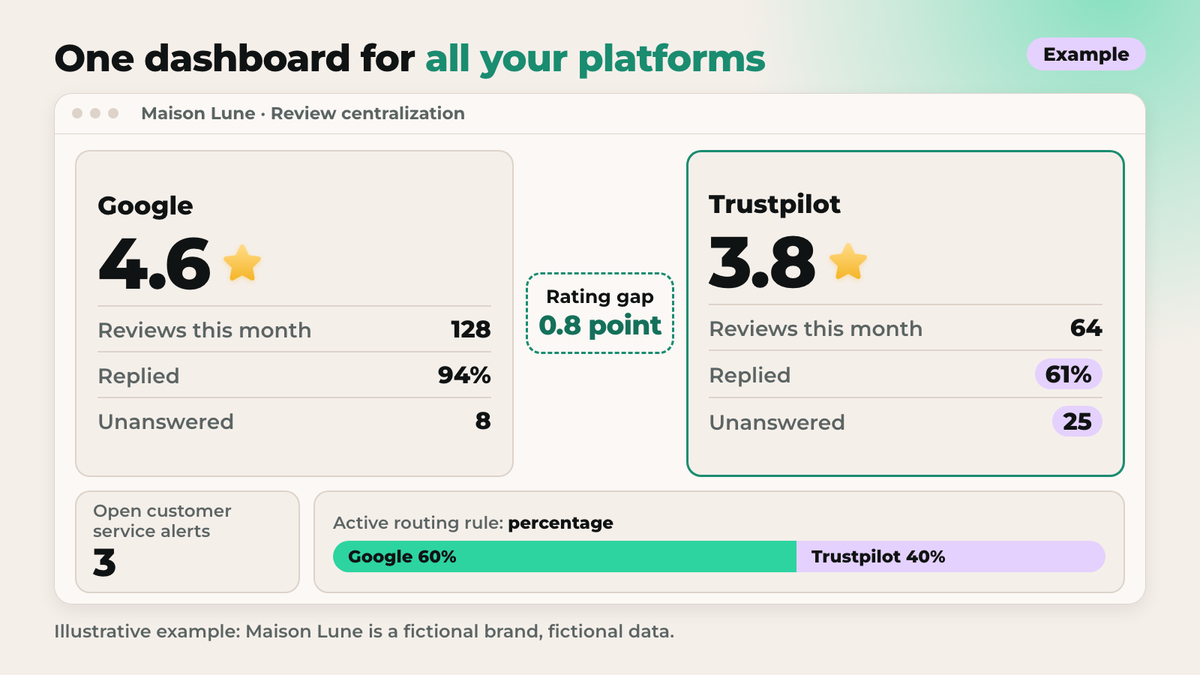
We can't promise this makes an AI assistant mention you. You do stop managing five profiles by hand, your replies stay consistent and a gap between platforms becomes visible the day it appears.
Start with one afternoon. List your platforms. Compare the rating and the reply gap between them. Then set one routing rule. If the platforms differ, you now know where the next happy customers should go.



Your next order deserves a review. We take care of it.
SMS and WhatsApp collection, mediation for unhappy customers, AI replies on every published review. Live in 48 hours, no developer needed.
Free demo×30 reviews in the first month · A personalized AI reply to every review
Frequently Asked Questions
Analyze with AI
Ask your questions about "Which Review Platforms Do AI Assistants Actually Cite?" with your preferred AI

Growth Hacker
Your customers have reviews to give. We collect them for you.
20 minutes with a Review Collect expert. You leave with a concrete collection plan for your brand.