GEO: Do Trustpilot Reviews Help ChatGPT Cite You?
Brands with a Trustpilot profile are cited far more often by AI engines (Seer), though the data cannot show that reviews are the reason. Here is what nine studies say, and what to do first.
 Victor· Growth Hacker
Contents
- Do customer reviews change what ChatGPT says about your brand?
- Which review platforms do AI engines actually cite?
- Why do the studies disagree so much?
- Does a Trustpilot profile make ChatGPT recommend you?
- What about G2, Yelp and Google reviews?
- Is Reddit still the source AI trusts?
- What should an ecommerce brand do first?
- What don't we know yet?
- How Review Collect feeds these review sources
TL;DR
- →Do reviews help? The data points that way: brands with a review profile are cited far more often by AI engines (median 1% vs 53.5%, per Seer), but that is only an association.
- →Collecting reviews and replying to them is what a brand can act on directly, so continuous collection is the action we recommend.
- →Claim your Google Business Profile, pick ONE third-party platform and collect continuously; no study ranks platforms for ecommerce.
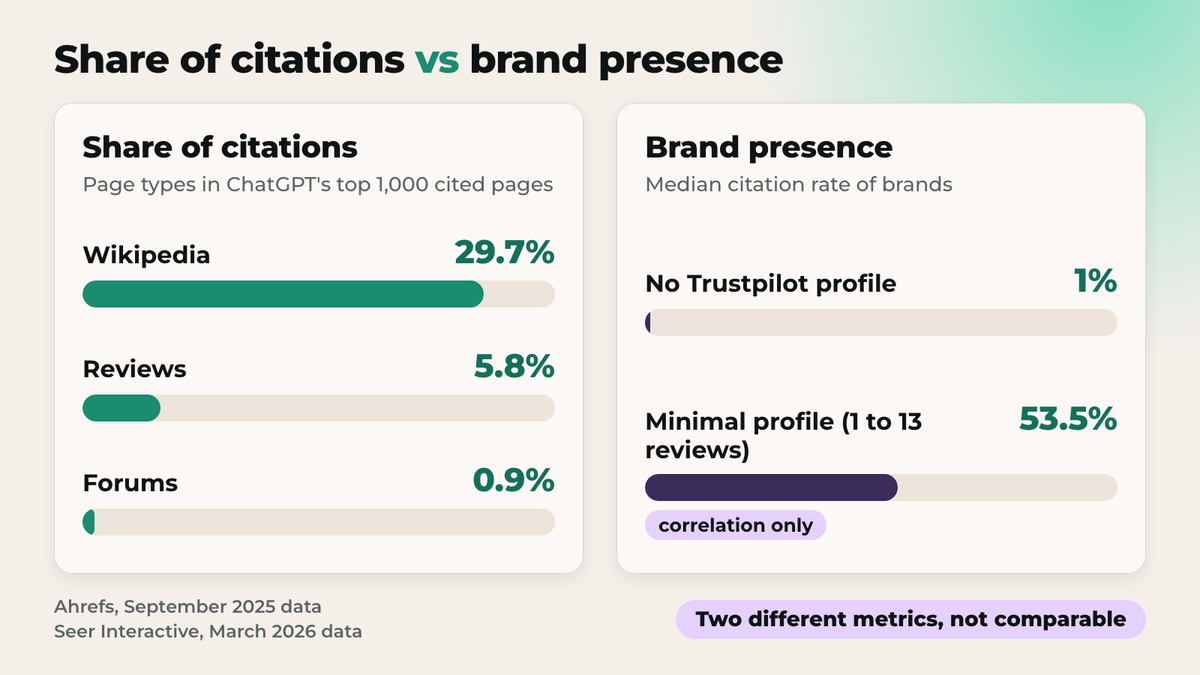
Do reviews help? The data points that way. According to the Seer Interactive study, which covers four AI platforms, ChatGPT among them, brands with a review profile are cited far more often by AI engines: a median of 1% with no Trustpilot profile against 53.5% with a minimal one (a profile with 1 to 13 reviews, per Seer). These are different measures: Seer counts brands that are cited at all, other studies count the share of all citations. That is a correlation, not proof of cause. Still, collecting reviews and replying to them is what a brand can act on directly, so a steady flow of fresh reviews is a reasonable bet, not a proven lever: on Google, on one third-party platform, and on your own site with structured data, the markup that tells search engines the average rating and number of reviews. GEO means optimizing your brand to appear in AI answers, and a citation is a link shown in the AI's answer (a mention is a brand name written without a link).
Do customer reviews change what ChatGPT says about your brand?
Brands with customer reviews are cited far more often by AI engines, though that is only an association. Seer Interactive studied 804,491 AI responses from ChatGPT, Gemini, Perplexity and Google's AI Mode (AI Mode and AI Overviews are AI-generated answers inside Google). Brands with a minimal Trustpilot profile (1 to 13 reviews, per Seer) were cited far more often than brands without one. Seer itself says marketing spend and audience size may explain part of the gap, so the study describes who gets cited, not what made them so.
There is also a plausible mechanism, though it stays a hypothesis. A review describes your product in a buyer's words, with delivery and support details your own pages rarely state. That is raw material an engine could use when it describes you. We cover that mechanism, and what the wording of reviews means for search and AI answers, in how review semantics affect SEO, GEO and AEO.
Reviews take a small share of citations, though. Among the 1,000 pages ChatGPT cited most in September 2025, reviews accounted for 5.8%, while Wikipedia took 29.7%. So reviews may shape how an engine describes a brand more than they dominate its citation list, and no study measures what one extra review does to one answer. The two findings measure different things, so they don't contradict each other.
Which review platforms do AI engines actually cite?
AI engines cite review platforms rarely and unevenly, and the figure changes with the study. The table lists nine measurements of AI citations, with the date, the sample and the caveat for each, including one from Ahrefs' Brand Radar, a tool that tracks which sites AI engines cite.
| Source | Date | Sample | What it measures | Caveat |
|---|---|---|---|---|
| Seer Interactive | May 14, 2026 (data from March 2026) | 804,491 responses, 1,926 brands, 4 AI platforms | Median citation rate of brands: 1% with no Trustpilot profile, 53.5% with a minimal profile (1 to 13 reviews) | Correlation, not causation. Trustpilot promoted the study. Country and language not stated |
| Ahrefs, top cited pages | Oct 28, 2025 (data from Sept 2025) | Top 1,000 pages cited by ChatGPT | Page types: Wikipedia 29.7%, reviews 5.8%, forums 0.9% | Categories assigned with an AI tool. "Reviews" is not defined. The publisher sells SEO or review tools |
| Ahrefs Brand Radar | Updated Nov 3, 2026 | US, broad queries | Share of citations by domain: Wikipedia 10.1%, Reddit 6.2%, Trustpilot 1.7% (22nd) | Monthly figure that moves. The publisher sells SEO or review tools |
| Semrush | Nov 10, 2025 | 230,000+ prompts, July 14 to Oct 12, 2025, 3 LLMs | Share of responses that cite a domain | Large swings over 13 weeks. Does not mention review platforms. The publisher sells SEO or review tools |
| SE Ranking | Jan 29, 2026 | 30,000 US commercial keywords | Google AI Overviews: 34.5% cite at least one review platform. Gartner 26.0%, G2 23.1%, Capterra 17.8% of platform links | Not ChatGPT. Software review sites. The publisher sells SEO or review tools |
| Evertune | Jun 30, 2026 | About 6.5M prompts, 5 AI platforms | Review domains: 2.2% of Perplexity citations. Top review domain on ChatGPT: Gartner, 0.2% | The publisher sells SEO or review tools |
| BrightLocal | Aug 26, 2026 | 1,967,762 citations, local businesses in the US, UK and Australia | ChatGPT citations: Yelp 99,281, Trustpilot 1,136. Google Business Profile absent from ChatGPT's top 10 | Local businesses only. No UK breakdown. The publisher sells SEO or review tools |
| Yext | July 2026 | 155.5M citations, 1,623 brands, Q1 2026 | Reviews and social: 2.6% of OpenAI citations, 19.5% of Anthropic citations | Reviews and social are grouped. The publisher sells SEO or review tools |
| AuthorityTech | Nov 3, 2026 | 8,343 ChatGPT API runs | Share of runs: G2 0.77%, Trustpilot 0.10%, Yelp 0.02% | Vendor source, as its page labels itself. API runs with web search, not the ChatGPT app |
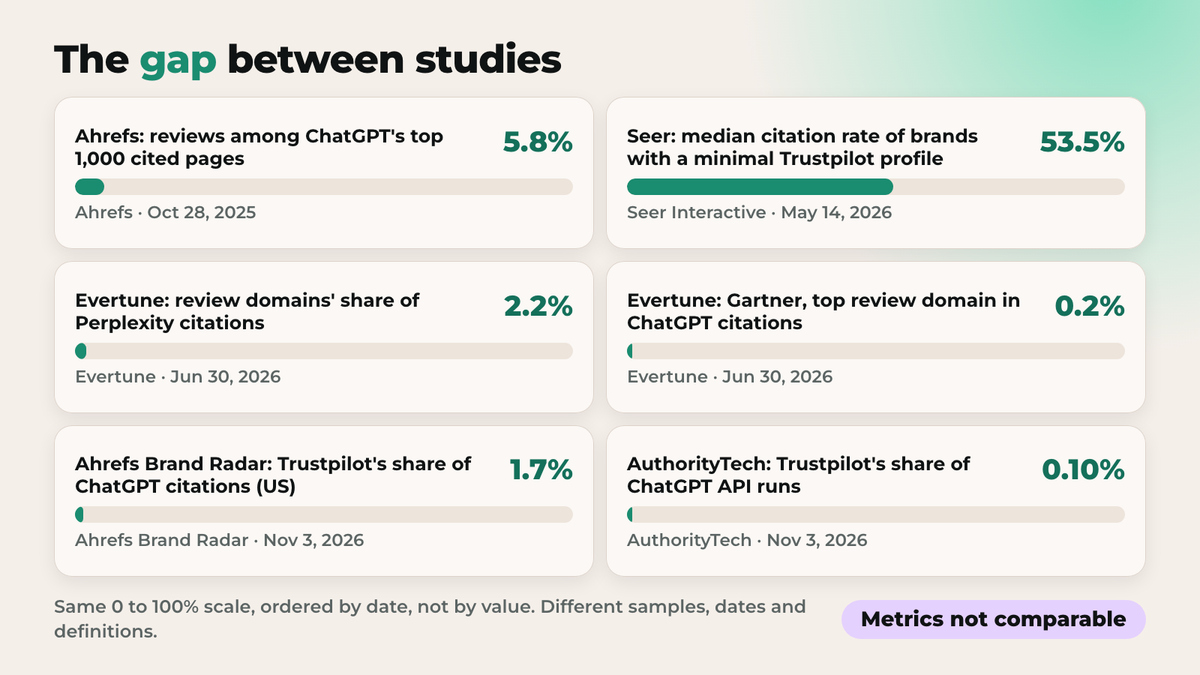
Two things stand out. First, engines differ. In the same Evertune data, Perplexity gives review domains 2.2% of its citations, while ChatGPT's top review domain, Gartner, gets 0.2%. Second, local and software samples behave differently again.
Across the ChatGPT measurements, review sites take anywhere from about 0.1% to 5.8% of ChatGPT's top 1,000 cited pages, the broadest count, by Ahrefs, depending on the definition. Each figure covers a different slice of the citations.
How should you read the table?
Start with the metric, then the sample, then the publisher. A share of citations tells you how often a domain appears among all the links an engine gives. A citation rate tells you how many brands appear at least once. Both are valid, but they answer different questions, so you can't rank one against the other. Next, check who the sample covers: US commercial keywords, local businesses, or brands in unstated markets. Finally, check what the publisher sells. Some of these companies sell review or listing tools, so their findings may lean toward the topic they sell.
Why do the studies disagree so much?
The studies disagree because they count different things. Seer measures the median citation rate across brands. Ahrefs and Yext measure the share of citations. Semrush measures the share of responses that include a domain. A brand can look strong on one scale and tiny on another without any contradiction.
Source matters too. Most of these studies come from companies that sell tools, and AuthorityTech sells a visibility index.
Dates matter as well. Some figures swing within weeks, so a figure from March can be stale by June.
Finally, the samples differ. SE Ranking's keywords are US and commercial, BrightLocal's are local businesses in three countries, and Seer does not state its markets. So don't average these numbers. Pick the study closest to your market and engine instead.
Does a Trustpilot profile make ChatGPT recommend you?
Brands with a minimal Trustpilot profile are cited far more often than brands without one, but no study shows that a profile makes ChatGPT recommend you. In Seer's data, the gap is large. Seer Interactive ran 804,491 responses across four AI platforms in March 2026. Its headline figure is this:
1% vs 53.5%. Median citation rate for brands with no Trustpilot profile (1%) versus brands with a minimal profile of 1 to 13 reviews (53.5%). Correlation, not causation. Trustpilot promoted the study, and country and language are not stated.
So a minimal profile goes along with much more presence in AI answers, and the study cannot tell us why. Other measurements are far lower (1.7% of ChatGPT citations for Trustpilot in Ahrefs Brand Radar, 0.10% of runs for AuthorityTech), but as noted above they count a different thing. Besides, being cited is not being recommended.
- Collect reviews by email, SMS, WhatsApp and QR code
- Send happy customers to the platform you choose
- Reply to every published review in your brand voice

What about G2, Yelp and Google reviews?
The right platform depends on your category, because B2B, local and ecommerce answers differ. SE Ranking looked at 30,000 US commercial keywords and found that 34.5% of Google AI Overviews cited at least one review platform.
Gartner Peer Insights, G2 and Capterra accounted for 26.0%, 23.1% and 17.8% of those platform links. These are software review sites, so the result speaks to B2B software buyers. It does not transfer as is to a shopper choosing a jacket.
For local businesses, BrightLocal counted 99,281 ChatGPT citations of Yelp against 1,136 of Trustpilot, across business locations in the US, UK and Australia, and Google Business Profile did not appear in ChatGPT's top 10. So Yelp matters for local queries on ChatGPT. But that sample covers local businesses, not online retail.
Google reviews have no direct measurement in these studies. That is a gap in the data, not evidence that they don't count. A Google Business Profile is free and it is the base of your visibility in Google's own results. And no study ranks platforms for ecommerce, so any ranking you read is an opinion.
Is Reddit still the source AI trusts?
Customer opinions also live in forums, which compete with review platforms as a source. According to Semrush, the share of ChatGPT responses that cited Reddit fell from about 60% to about 10% between early August and mid-September 2025. So don't build your plan on one source's current weight.
What should an ecommerce brand do first?
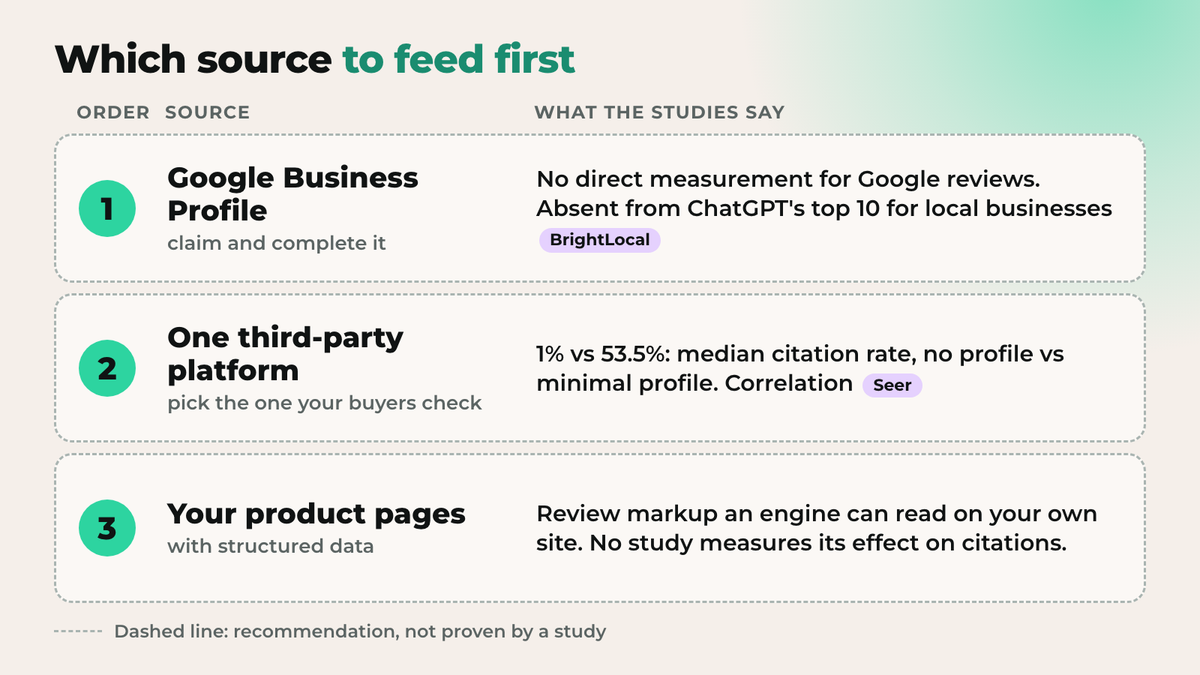
An ecommerce brand should start with Google, settle on a single third-party platform, and make reviews readable on its own site. Here is the order we recommend, based on what the studies support and what they leave open. The first three steps are one-time setups, and the last two are habits you keep.
- Claim and complete your Google Business Profile. Add your details and start collecting reviews there. The reason to start with Google is Google itself, not ChatGPT: no study shows a Google profile affects ChatGPT answers.
- Pick ONE third-party platform. Choose the one your buyers already check, and stick with it.
- Publish reviews on your own pages with structured data. Product pages should carry review markup, so engines can read the average rating and number of reviews.
- Collect continuously. Reviews do not dominate the list of cited sources, but the gap Seer measured points their way, and collecting them costs little beyond what you already do for customers.
- Reply to every review, positive and negative, in your brand voice.
For the broader plan, see our guide to GEO for ecommerce.
Why one third-party platform and not three?
A single profile with fresh reviews is easier to keep alive than three thin ones. The studies don't show that spreading across several platforms raises your chances of being cited, and they don't show the opposite either. What they do show is that platform shares vary a lot between studies and over time. So concentrating your effort on one source plus Google is a reasonable bet, not a proven one. The cost stays low because you are collecting the reviews anyway. Choose by your buyers' habits, not by a ranking, because none exists for ecommerce. Ask your support team and your customers where they check reviews before buying. If the answer is split, take the platform your category already uses most. You can revisit the choice in six months, once you have your own numbers.
What don't we know yet?
We don't know whether reviews cause AI citations. A brand with 500 reviews on a platform is probably also a brand with more traffic and more press.
We also don't know how much Google reviews count for ChatGPT. Nor do we know which platform works best for a consumer ecommerce brand, because the SE Ranking figures cover software review sites and BrightLocal's cover local businesses.
Other gaps remain. Seer does not state its countries and languages, so you can't tell whether the result holds for a US store. And we don't know whether review volume, recency or wording matters most to an engine.
Treat every claim in this space, ours included, as provisional.
How can you check your own brand?
Ask ChatGPT, Gemini, Perplexity and Claude the questions a buyer would ask about your category, and write down whether your brand appears, how it is described and which pages are cited. Then repeat the same questions next month. AI perception is a Review Collect tool that asks five AIs (ChatGPT, Claude, Gemini, Mistral and Perplexity) about your brand and returns a verdict on how each one describes you. That gives you a baseline for your own AI visibility. A baseline matters because every figure in this article comes from other brands' data. Your own answers tell you whether the reviews you have today show up at all, and which review gaps to fix first. For the full playbook on AI reputation management, see our guide to the review platforms assistants cite.
How Review Collect feeds these review sources
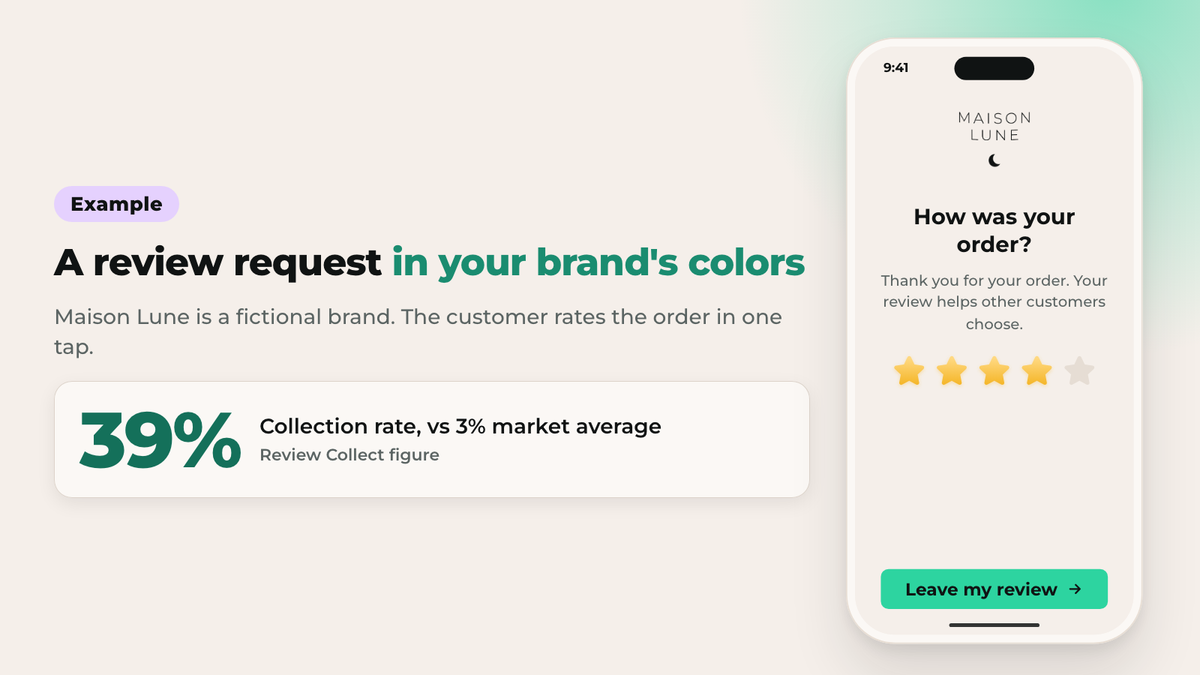
Review Collect handles review collection by email, SMS, WhatsApp and QR code, synced with delivery tracking, with a 39% collection rate against 3% on average across the market (Review Collect's own figure, not an independent study).
You decide where satisfied customers (4 and 5 stars) go: Google, Trustpilot or another platform. Each customer lands on one platform at a time, so your volume builds on the source you picked in the checklist.
What happens to unhappy customers?
Customers who give 1 to 3 stars land on a feedback page in your brand's colors, and Review Collect sends an email alert to your support team with the feedback and order details. The customer still chooses whether to publish a review, and nothing is blocked.



Your next order deserves a review. We take care of it.
SMS and WhatsApp collection, mediation for unhappy customers, AI replies on every published review. Live in 48 hours, no developer needed.
Free demo×30 reviews in the first month · A personalized AI reply to every review
Frequently Asked Questions
Analyze with AI
Ask your questions about "GEO: Do Trustpilot Reviews Help ChatGPT Cite You?" with your preferred AI

Growth Hacker
Your customers have reviews to give. We collect them for you.
20 minutes with a Review Collect expert. You leave with a concrete collection plan for your brand.