

UGC Marketing for E-Commerce: Turn Your Customers Into Creators
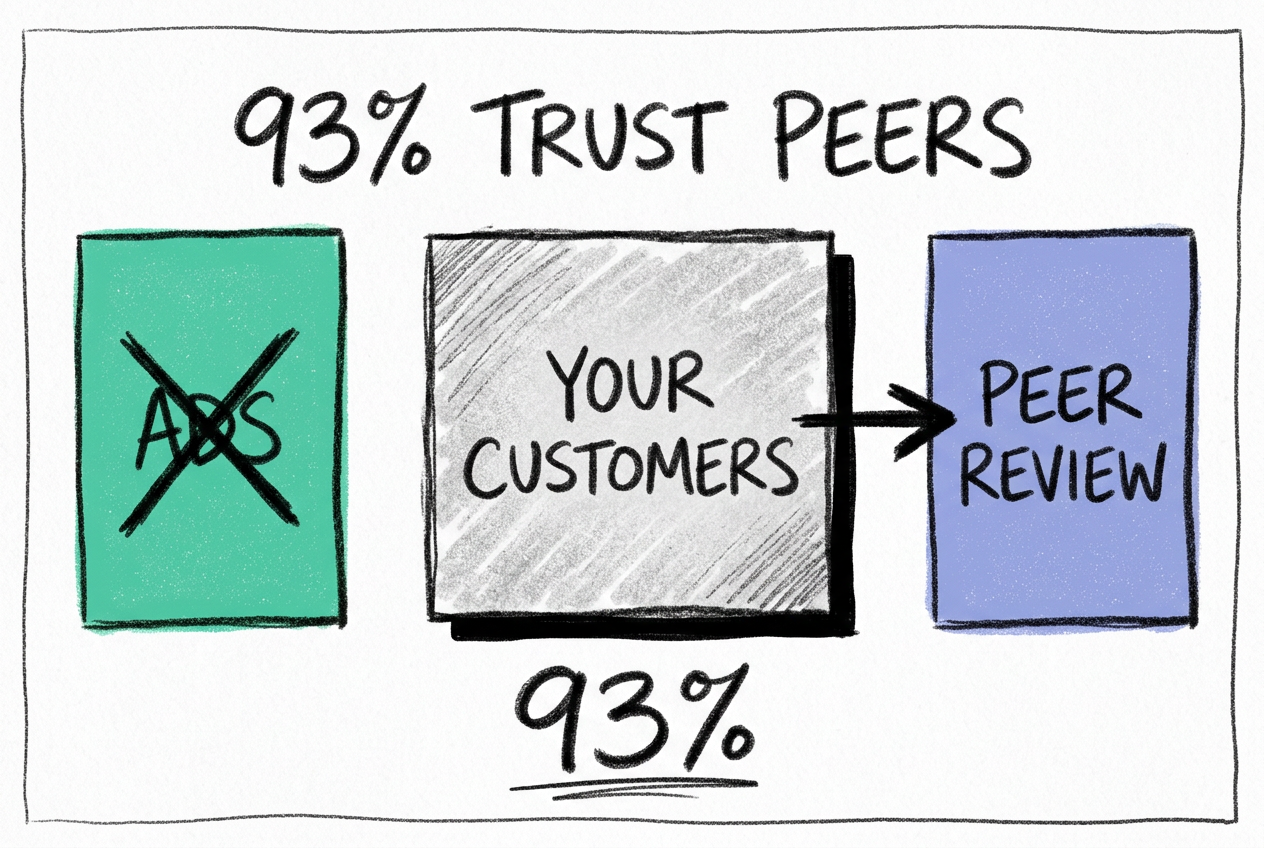
93% of buyers trust peer reviews more than brand advertising. Your customers are already producing UGC. Here's how to collect it and activate it across every channel.
 Victor· Growth Hacker
Contents
- What Is UGC and Why E-Commerce Brands Need to Act Now
- Your Customer Reviews Are Your First UGC Asset
- Post-Purchase UGC Pipeline: Collect Without Friction
- Activate Your UGC Everywhere: Widgets, Ads, Newsletters, Product Pages
- UGC and AI: What Changes in 2026
- How Review Collect Structures Your UGC Pipeline
TL;DR
- →Your customer reviews are your first UGC asset: indexable, reusable in ads and widgets, with no additional rights.
- →A post-purchase pipeline (email + SMS + WhatsApp) can reach up to 39% response rate, versus the 2-3% industry average.
- →Widgets, Seller Ratings, newsletters, and product pages are the four priority activation channels.
- →In 2026, having a verified, recent review corpus determines your visibility in AI-generated responses.
93% of consumers trust content created by other customers more than any brand advertisement (Ifop, 2026). Your customers are already publishing reviews, photos, videos. That content is UGC — and it's your strongest conversion lever, provided you know how to collect and reuse it.
What Is UGC and Why E-Commerce Brands Need to Act Now
User Generated Content (UGC) is any content created by your customers, not your marketing team: written reviews, product photos, unboxing videos, social media posts.
Two categories matter:
Organic UGC: published spontaneously, without prompting. Your customer photographs their parcel and posts it on Instagram. You asked for nothing.
Solicited UGC: produced in response to an invitation. A post-purchase email, an SMS 48 hours after delivery, a WhatsApp review request.
Solicited UGC is the only kind you actually control. It can be tracked, measured, and reused.
For e-commerce, that distinction is everything. Organic UGC shows up if you're lucky and have an active community. Solicited UGC gets built with a process. And it's that process that determines your results.
Your Customer Reviews Are Your First UGC Asset
Most e-commerce brands think about UGC through the lens of video or creators. They forget that their customer reviews — those few lines left on Google, Trustpilot, or their website — are already UGC. Textual UGC, indexable, quotable, reusable in ads.
A customer review has three advantages a TikTok video doesn't: it's published on a high-authority platform (Google Business, Trustpilot), it contributes to your organic rankings through star rich snippets, and it can be reused in your ads, newsletters, and product pages with no additional rights.
+73% average order value among buyers who read reviews before purchasing. (Review Collect data)
| UGC type | Collection effort | Conversion impact |
|---|---|---|
| Written reviews (Google, Trustpilot, RC) | Low — automated post-purchase request | Very high (SEO, ads, product pages) |
| Customer photos | Medium — targeted request + incentive | High (product pages, visual ads) |
| Customer videos | High — creator brief + approval | High (social media, video ads) |
| Organic social posts | None — you don't control them | Low to medium (awareness) |
The hierarchy is clear: written reviews deliver the best effort-to-impact ratio of any UGC type. Build that foundation before investing in creator content.
Post-Purchase UGC Pipeline: Collect Without Friction
Most merchants collect reviews on 2 to 3% of their orders. That's not a customer motivation problem. It's a timing and channel problem.
A review gets written in the 48 to 72 hours after the package arrives, when the experience is still fresh. After that window closes, response probability drops by 60%.
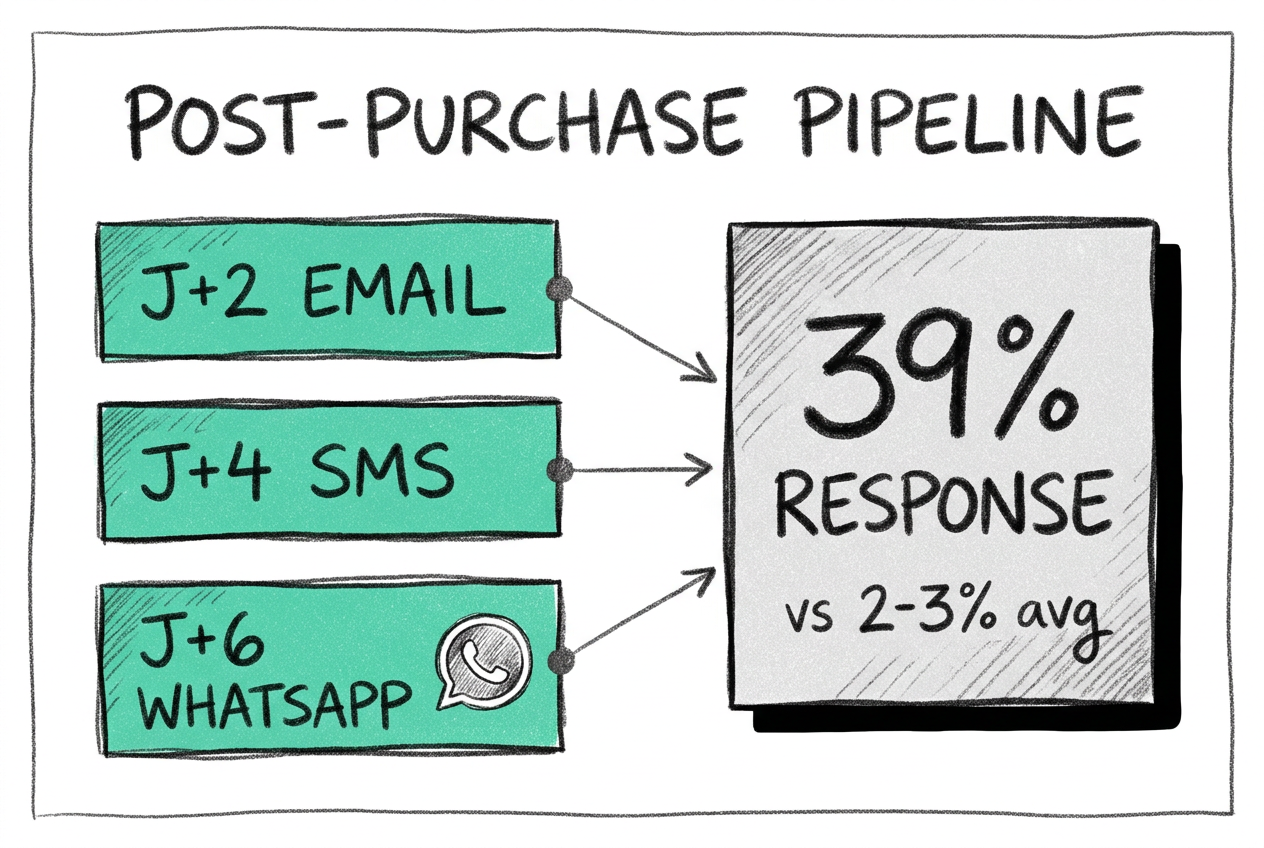
The pipeline that works: D+2 review request email with a direct link to the target platform, D+4 SMS follow-up if no response (open rate: 98%), D+6 WhatsApp if the customer opted in to that channel.
With this sequence, Review Collect reaches up to 39% response rates. Industry average sits at 2-3%. Merchants who switch to this workflow see their review volume multiply by 30 in the first month.
That volume changes everything. Not just for your rating — for your ability to reuse that content across every marketing channel.
Activate Your UGC Everywhere: Widgets, Ads, Newsletters, Product Pages
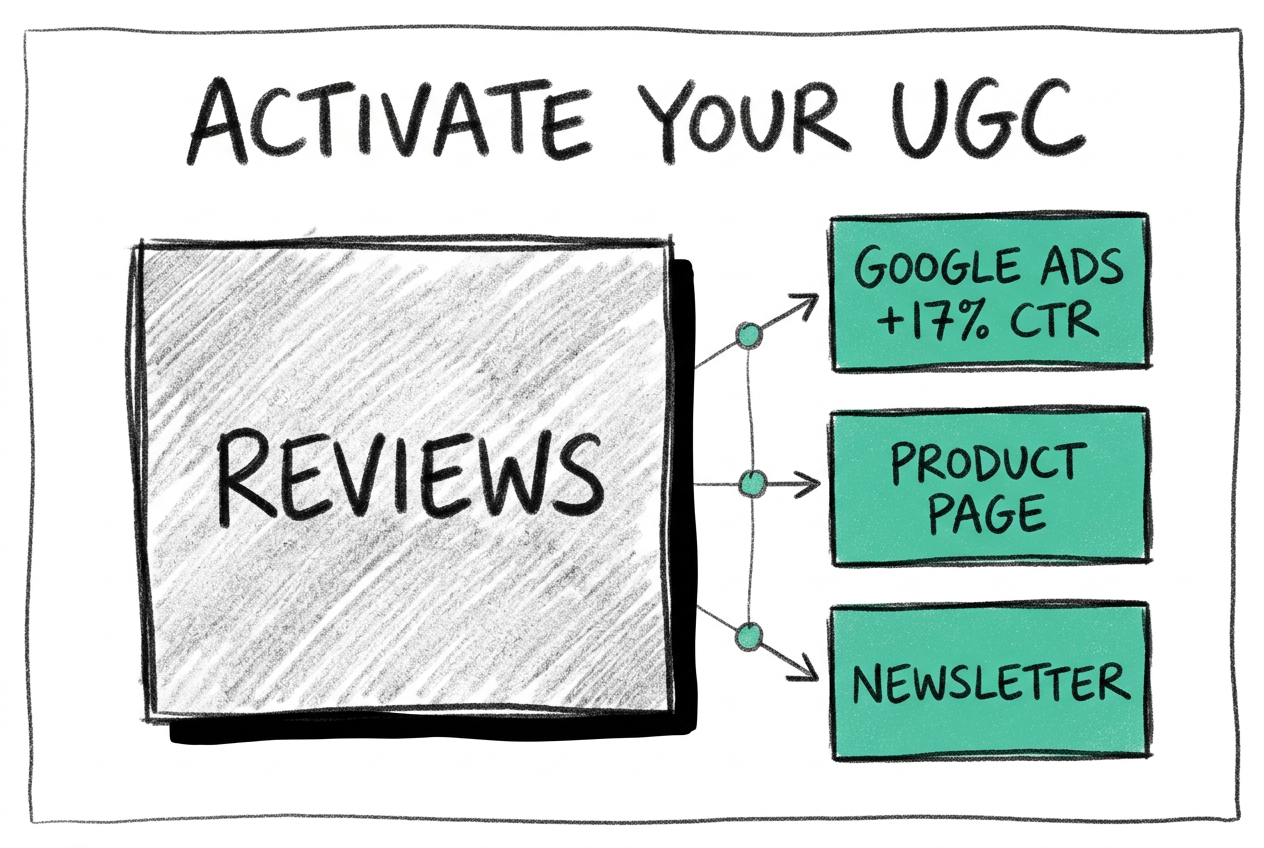
Collecting reviews without redistributing them means leaving money on the table. Here are the four activation channels to set up.
Review widgets on your site
A review widget displays your best ratings and verbatims on your homepage, product pages, and checkout. The effect is immediate: visitors see social proof at the moment they decide. On product pages, it's often the difference between "add to cart" and closing the tab.
Reviews in your Google Ads
Google Seller Ratings display your score automatically beneath your text ads. Campaigns with Seller Ratings average +17% CTR versus ads without a rating. Requirement: at least 100 recent reviews in the past 12 months on a Google-recognised aggregated source.
UGC in your newsletters
Each week, select a recent top-rated review and include it in your newsletter. A first name, a rating, two sentences. It's often the most-read section of the email — ahead of promotional offers. And you write nothing.
Product pages: rating + review excerpt
The star rating reduces purchase hesitation. The text excerpt handles objections. "True to size", "Delivery was fast", "I recommend it for sensitive skin": those few words do more than any marketing bullet point.
Activate your UGC across every channel
Connect your store in 48 hours and turn every order into reusable UGC content.
- ×30 reviews in your first month
- Automatic distribution to Google, Trustpilot, and your product pages
- Live in 48 hours, no developer needed
UGC and AI: What Changes in 2026
AI search engines (ChatGPT, Perplexity, Google AI Overviews) don't synthesise just any content. They favour brands with a structured, recent, and authenticated review corpus.
Concretely: a brand with 400 verified reviews published in the last 6 months is more likely to appear in an AI response than a competitor with 1,200 old, stale reviews. This isn't a secret algorithm. It's the same logic as SEO: fresh, structured content wins.
The EU Omnibus Directive requires brands to display only verified reviews from real buyers. Unverified UGC, purchased reviews, inflated ratings — all now carry legal exposure. A verified review corpus is no longer just a marketing argument. It's a legal obligation.
UGC draws its power from the social proof it generates, and your best UGC becomes a formidable advertising asset in your Instagram ads with reviews.
How Review Collect Structures Your UGC Pipeline
Review Collect connects your store (Shopify, WooCommerce, PrestaShop) to your collection pipeline in 48 hours, no developer needed. Every order automatically triggers a review request on the right channel, at the right time, in the right language.
Collected reviews are centralised, distributed to your target platforms (Google, Trustpilot, Verified Reviews), and ready to reuse directly in your widgets, ads, and newsletters.
Results in the first 30 days: ×30 review volume, up to 39% response rate, +73% average order value among buyers who read those reviews.
Your customers already have something to say about your brand. We make sure you capture it — and that it works for you. Discover how to deploy this strategy for your e-commerce.
Frequently Asked Questions
Analyze with AI
Ask your questions about "UGC Marketing for E-Commerce: Turn Your Customers Into Creators" with your preferred AI

Growth Hacker
Related articles
RCS for customer review collection: what changes in 2026
Aug 10, 2026

B2B and SaaS Customer Reviews: Why They're Harder to Collect (and How to Automate Them)
Aug 3, 2026

Social Proof Marketing: Definition, Types, and How Customer Reviews Make It Work
Jul 23, 2026