

LTV (Customer Lifetime Value) measures the total revenue generated by a customer throughout their relationship with your brand. Master LTV calculation to optimize your marketing investments and maximize e-commerce profitability.

LTV (Lifetime Value), also known as Customer Lifetime Value or CLV, represents the total revenue a customer generates for your business throughout their relationship with your brand. It's one of the most strategic metrics in e-commerce.
Unlike transactional metrics that focus on a single purchase, LTV takes a long-term view. It helps you understand the true value of each acquired customer, beyond their first purchase.
For e-commerce businesses, knowing your LTV radically changes decision-making:
LTV is intrinsically linked to other key metrics such as average order value, retention rate, and customer loyalty.
There are several methods to calculate Lifetime Value, from the simplest to the most sophisticated.
The most accessible formula to start with:
LTV = Average Order Value x Annual Purchase Frequency x Customer Lifespan (in years)
Concrete example: A customer with an average order value of $75, purchasing 3 times per year and staying loyal for 4 years generates an LTV of $900.
For a more precise view of actual profitability:
LTV = (Average Order Value x Gross Margin) x Purchase Frequency x Customer Lifespan
This approach integrates your margin to calculate the actual profit generated per customer.
Mature businesses use predictive models including:
Customer Lifetime Value transforms your business approach in several major ways.
Knowing your LTV allows you to define a profitable maximum customer acquisition cost (CAC). The golden rule: your LTV should be at least 3 times higher than your CAC.
If your average LTV is $300, you can invest up to $100 to acquire a customer while remaining profitable.
Not all customers have the same value. LTV analysis by segment reveals:
LTV highlights the importance of retention. Increasing your retention rate by just 5% can boost your profits by 25% to 95% according to studies.
Investing in loyalty becomes obvious when you understand its impact on LTV.
A rising LTV indicates a strengthening customer relationship. It's a much more reliable business health signal than simple revenue.
Review Collect directly acts on the levers that increase your customer lifetime value.
Authentic customer reviews create a virtuous cycle:
Thanks to integrated NPS surveys, Review Collect identifies your promoters — those high-LTV customers who actively recommend your brand.
Review Collect's automated sequences maintain the connection with your customers:
Each interaction strengthens the relationship and extends customer lifespan.
Analysis of customer verbatims reveals what really matters to them. These insights allow you to adapt your offer and communication to maximize satisfaction — and therefore LTV.
By combining review collection, satisfaction analysis, and automation, Review Collect becomes an LTV accelerator for your e-commerce.
Automate review collection via WhatsApp, SMS, Email, QR Code and RCS. Reach a 39% response rate where the industry averages 2-3%.
Learn more
Decide where each review is published, when and how. Review Collect orchestrates distribution across Google, Trustpilot and your key platforms — happy customers go public, unhappy ones go through private mediation.
Learn more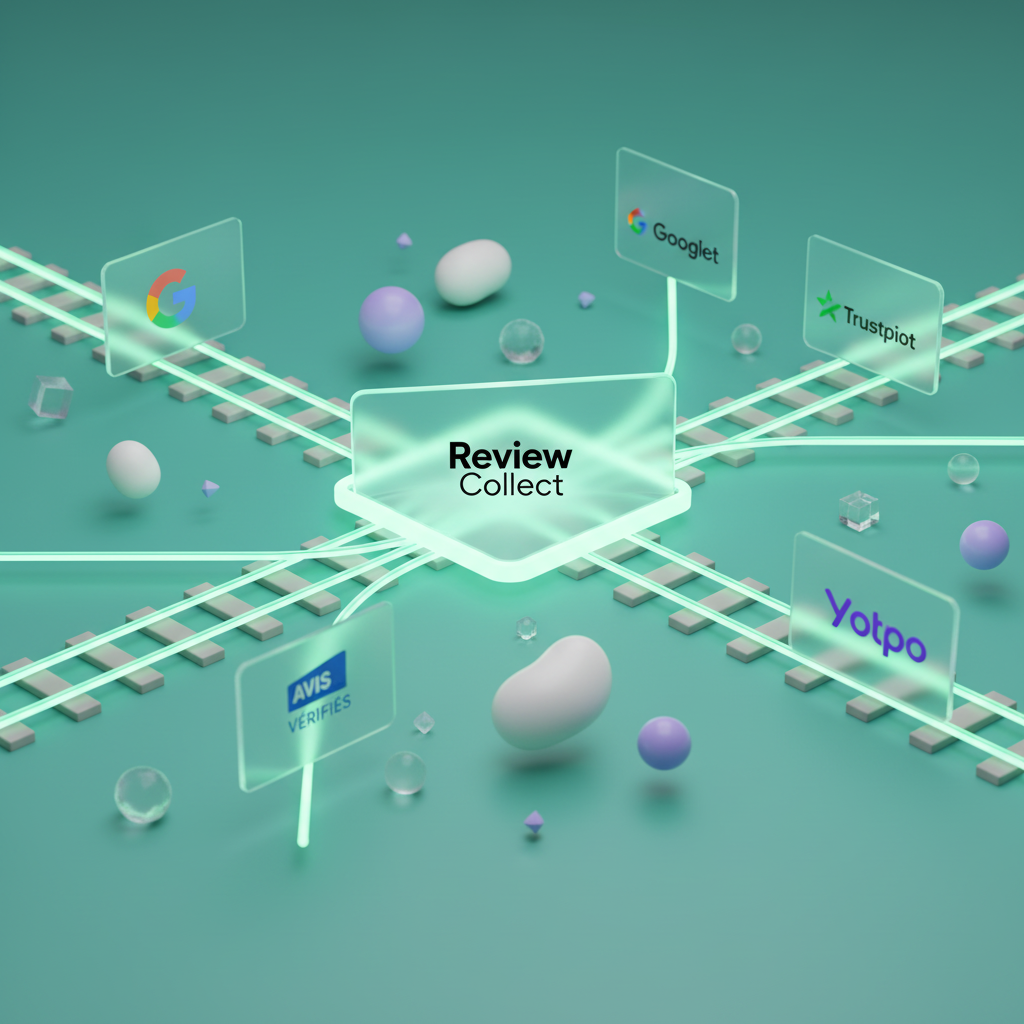
Our AI reads every review and drafts a personalised response in your brand voice — published directly to Google and Trustpilot in seconds, with zero manual work.
Learn more
The e-reputation solution that turns your customers into ambassadors. Automated collection of multi-channel customer reviews.


