Trust Badges or Real Reviews: What Makes Shoppers Buy?
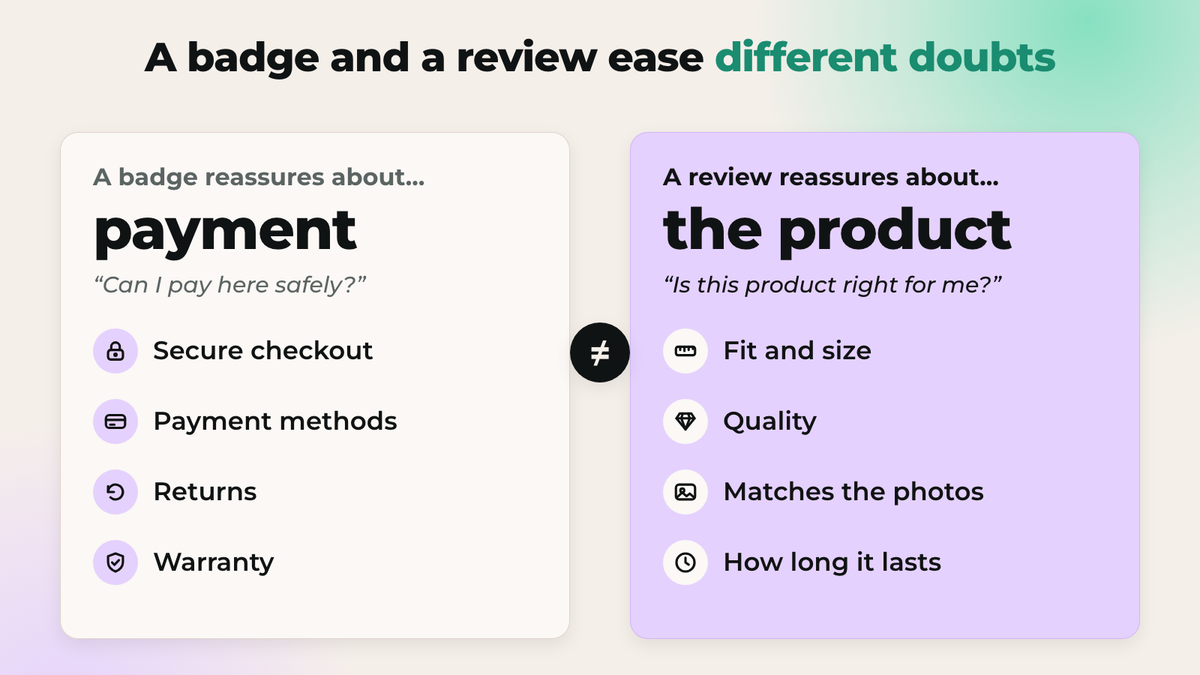
A trust badge reassures shoppers about payment. A real review reassures them about the product. If you have traffic but no sales, start with the second one.
 Victor· Growth Hacker
Contents
- Why is my store getting traffic but no sales?
- Do trust badges actually increase conversions?
- What do shoppers trust more, badges or real reviews?
- Which trust badges are worth keeping (and which are clutter)?
- What should product reviews look like to remove doubt?
- Are fake trust badges and fake reviews legal?
- What can you fix before Black Friday?
- How Review Collect helps you show real reviews on product pages
TL;DR
- →A badge calms doubt about payment, a review calms doubt about the product
- →Traffic without sales usually means shoppers doubt the product, so reviews come first
- →Keep 1 or 2 badges at checkout, check your 5 best-sellers, and start collecting reviews now
Trust badges reassure shoppers about payment. Real reviews reassure them about the product, and that is usually the doubt that stops a sale. So if your store has traffic but few orders, fix your product page reviews first and keep only one or two badges at checkout.
Why is my store getting traffic but no sales?
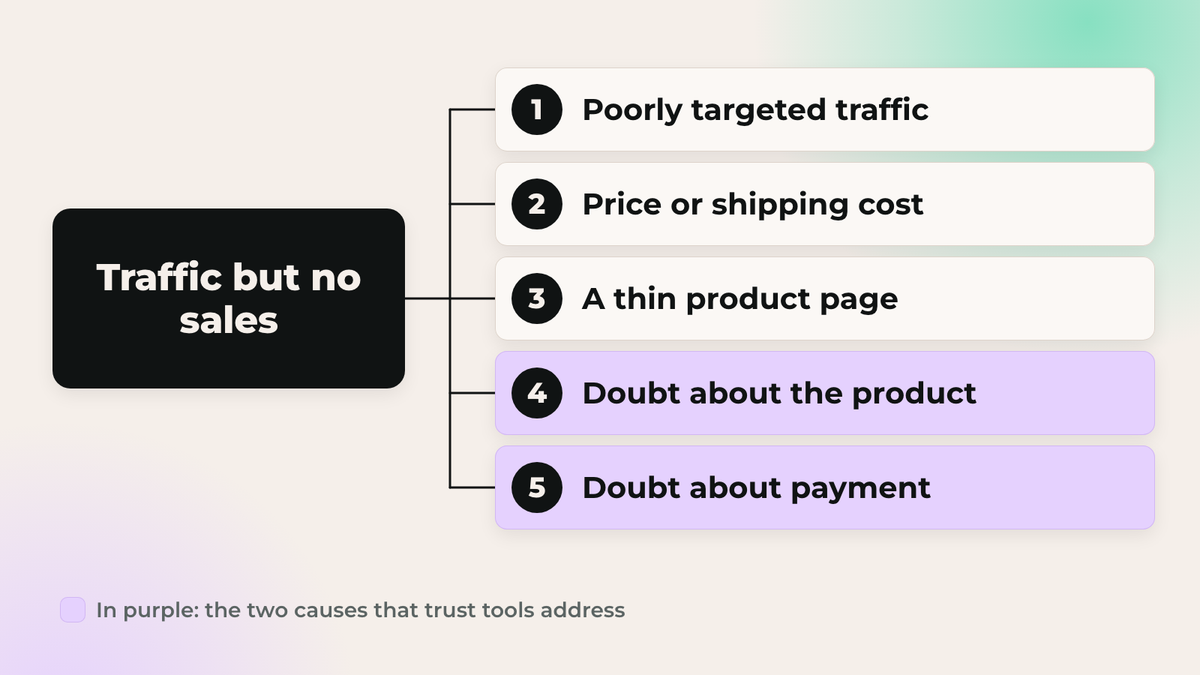
Most stores in this situation have a mix of causes, and trust is only one of them. Before you buy a badge app, rule out the other three. Here are all five.
- Poorly targeted traffic. Visitors who never wanted your product will never buy it. Check which campaigns and keywords bring the sessions, and cut the ones that attract the wrong audience.
- Price or shipping cost. A surprise shipping fee at checkout is a classic reason to leave. Show delivery costs early and compare your price with direct competitors.
- A thin product page. Two photos, one paragraph and no size guide leave too many questions open. Add detailed photos, a size or usage guide and answers to the questions customers ask most.
- Doubt about the product. Shoppers cannot touch it, so they look for proof from people who bought it.
- Doubt about payment. Shoppers do not know your brand and hesitate to type in their card number.
This article covers causes 4 and 5, because they are the two that trust tools address, and they are not the same problem. A badge answers the fifth. Only buyer feedback answers the fourth.
To tell which cause is yours, read your funnel in your analytics. Compare the add-to-cart rate on each product page, then the share of carts that reach payment. If visitors leave the product page without adding anything, the doubt is about the product, the price or a thin page. If they add to cart and then abandon at checkout, look at shipping cost or doubt about payment. Check this before you change anything, and see how to calculate your conversion rate if the metric is new to you.
Take an illustrative example, with made-up numbers. A store with 5,000 monthly sessions and a 0.5% conversion rate gets 25 orders. If 4,000 of those sessions come from a broad ad audience that never wanted the product, no badge will help. If instead most visitors reach the product page, read it and leave, the page itself is failing to answer them. Fixing the page so that 1 visitor in 100 orders would double those 25 orders to 50. A five-minute look at your analytics keeps you from installing the wrong fix the week before your biggest sales event.
Do trust badges actually increase conversions?
Trust badges matter at the payment step, but the evidence for big lifts is thin. In a 2025 Baymard Institute survey of 1,026 US adults, 19% said they had abandoned a checkout in the past 3 months because they did not trust the site with their credit card information. That is a measurable leak at the payment step.
On the other hand, the same Baymard article describes a 2023 seal test with a surprising result. A homemade seal outperformed SSL seals from most established vendors, with Norton the one exception. An SSL seal is a small logo from a security vendor saying the connection is encrypted. Shoppers may react to how secure a seal looks more than to who issued it, but this is a single test and may not apply to your store.
You will also see claims like "+42% conversions" or "75% of shoppers look for badges" on badge app pages. We found no primary study behind them, so we do not repeat them. Treat any badge statistic without a named study, a country and a year as marketing.
How to A/B test a badge honestly
Test it yourself instead of trusting anyone's number.
- Change one thing. Add or remove a single badge, not a badge plus a new button color.
- Get enough orders. A few dozen orders per variant proves nothing. Use a sample size calculator with your current conversion rate and the lift you want to detect, then wait until you reach that number.
- Wait for significance. Stopping the test on the first good day is how stores "prove" a lift that was noise.
- Run full weeks. Weekend and weekday shoppers behave differently, and Black Friday traffic is not normal traffic.
If your store gets only a few orders a day, a clean test may take weeks, so it is not a pre-Black Friday task. In that case, keep the badge only if it is accurate and cheap, and run the test after the sales peak.
What do shoppers trust more, badges or real reviews?
No source we found compares badges and reviews head to head. There is a solid measurement for reviews (below), and none from a primary source for badges alone, so what follows is reasoning, not a measured result. Reasoning suggests shoppers trust reviews more for product decisions, because a review comes from a buyer and a badge comes from the seller. A badge is a store's own claim. A review is a buyer telling you what happened.
The two answer different questions. A badge answers "will my card data be safe?". A review answers "will this product work for me?". With traffic but no sales, the second question is usually the one blocking the purchase.
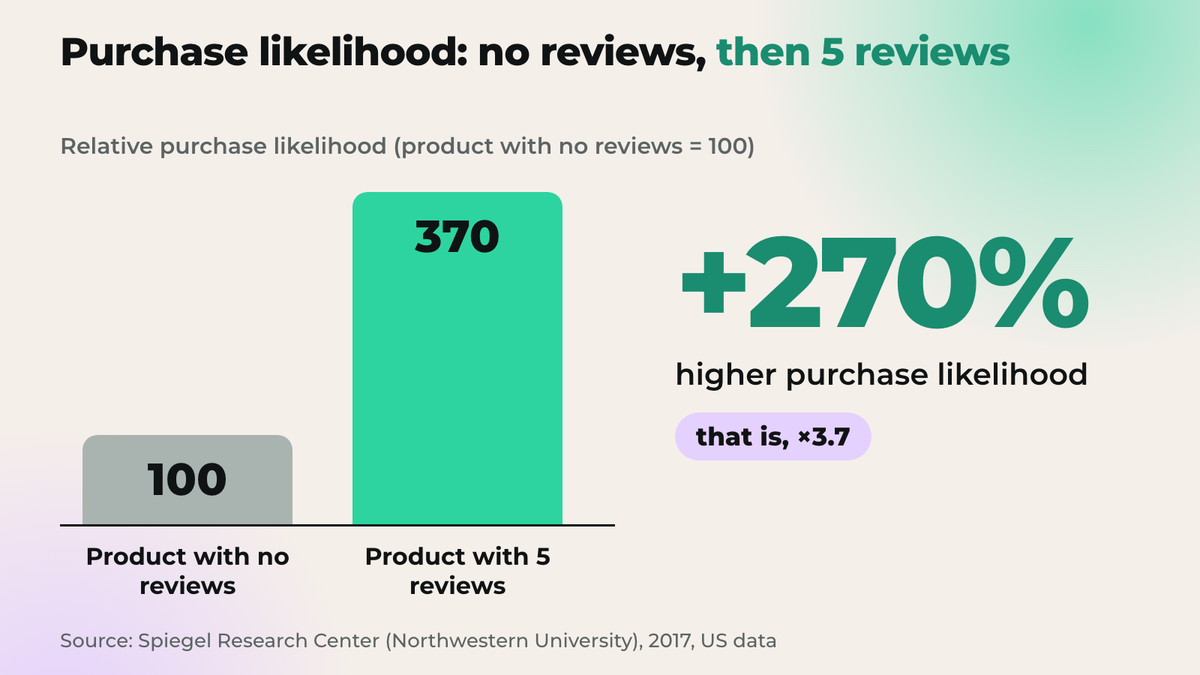
The Spiegel Research Center at Northwestern University, with US data first published in 2017, found that a product with 5 reviews has a purchase likelihood 270% higher than a product with none. The same research found that purchase likelihood peaks at ratings between 4.0 and 4.7 stars, then falls as ratings approach 5.0.
A product with 5 reviews is 270% more likely to be bought than one with none. Spiegel Research Center, Northwestern University, US data published 2017.
- Collect reviews by email, SMS, WhatsApp and QR code
- Photo reviews and product reviews in one place
- Show reviews on your product pages

Which trust badges are worth keeping (and which are clutter)?
Keep the badges that answer a concrete payment or delivery question, and drop the ones that only decorate. Every extra logo competes with your add-to-cart button, so each one must earn its spot.
| Badge | What it reassures | Verdict | Where to place it |
|---|---|---|---|
| Secure checkout (lock icon + short line) | Card data is protected | Keep | Next to the pay button |
| Payment logos (Visa, Mastercard, PayPal, Apple Pay) | You can pay the way you want | Keep | Checkout and cart footer |
| Money-back or free returns promise | Low risk if the product disappoints | Keep, if it is true | Product page, near the buy button |
| Shipping badge (delivery time, free shipping threshold) | No surprise at checkout | Keep, if it is accurate | Product page and cart |
| Homemade "100% secure" seal | Nothing verifiable | Drop | Nowhere |
| Paid third-party seal | Brand recognition, uncertain effect | Test before paying | Checkout only |
| Review rating widget (rating + count) | The product works for real buyers | Keep | Under the product title, near the buy button |
A good test of any badge is to ask what question it answers. "Free returns within 30 days" answers "what if it does not fit?". A grey shield with no text answers nothing. If you cannot name the doubt a badge removes, it is clutter.
In our view, a returns promise probably does more than a seal, because it removes a real risk for the shopper. A "100% secure" logo with no proof does the opposite. It is a claim, not evidence, and shoppers have seen thousands of them.
If your page has a long row of grey logos, remove everything except the secure checkout line and your payment logos, then give the freed space to your rating and review count.
What should product reviews look like to remove doubt?
Reviews remove doubt when they are visible, recent and numerous enough to look real. A single review from two years ago reads as a store with no buyers.
Check these six things on each product page:
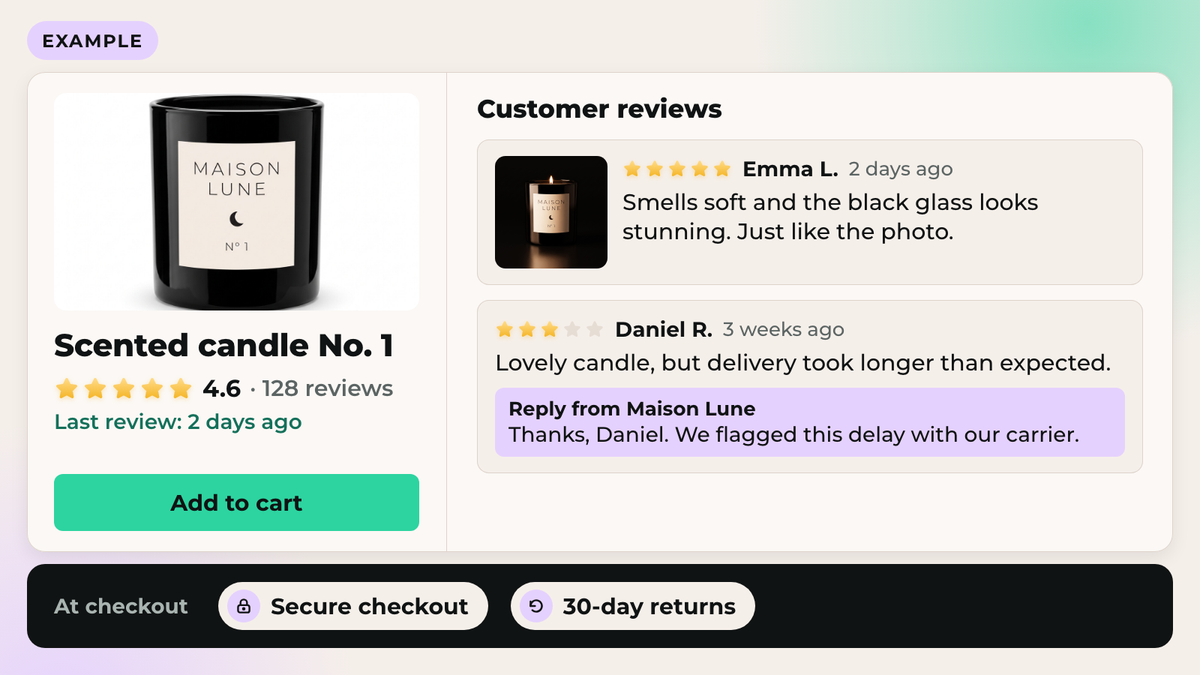
- Rating. Show the average and the count together. A rating between 4.0 and 4.7 converts better than a perfect 5.0, according to the Spiegel data above. Our article on the best star rating explains why shoppers distrust perfection.
- Volume. Aim for at least 5 reviews per product. Below that, the page behaves like a page with none.
- Recency. The date of the last review should be recent. Shoppers read it as "are people still buying this?".
- Photo reviews. A customer photo answers "does it look like the pictures?" better than any copy.
- Replies to negative reviews. A calm, specific reply shows how you treat a customer who has a problem.
- Position. Put the rating under the product title and a short review excerpt near the buy button, not three scrolls below.
Take a candle that arrived with a cracked jar. A 3-star review that says so, followed by a reply offering a replacement within a day, tells the next shopper two useful things. Breakage is rare enough to be mentioned, and you fix it fast. A wall of identical 5-star reviews with no detail tells them nothing, and it looks suspicious. Specific, mixed feedback is more believable than uniform praise.
Finally, check mobile. Most Black Friday traffic arrives on a phone, and a rating widget that loads below the fold does nothing for those shoppers.
Are fake trust badges and fake reviews legal?
Fake reviews are not legal, and fake badges are risky. Fake reviews are explicitly banned in the US, and displaying a seal you never earned is a misleading claim that the FTC treats as deceptive under its general authority. In August 2024, the Federal Trade Commission announced a final rule banning fake reviews and testimonials.
The rule covers several practices:
- Fake or AI-generated reviews and testimonials, including reviews from people who do not exist or never used the product.
- Paying for reviews conditioned on positive or negative sentiment.
- Undisclosed reviews from insiders, such as managers or their relatives.
- Review suppression through unfounded legal threats or intimidation.
- Buying fake social media indicators, such as bot followers or views, for commercial purposes.
The FTC says it can seek civil penalties against knowing violators.
On fake seals, we found no specific FTC wording in that announcement. In general terms, a seal that claims a certification or an inspection that never happened misleads shoppers, and misleading shoppers is what consumer protection law targets. Skip the made-up "Verified by" badge and show real reviews instead. EU sellers face similar rules, notably the EU Omnibus directive on reviews. This is general information, not legal advice, so check with a lawyer if your store sells in several countries.
What can you fix before Black Friday?
Black Friday 2026 is November 27, so you have days, not weeks. A review requested today for a new order will not arrive before Friday. What works this week is fixing what shoppers see and using the reviews you can still reach. This checklist is ordered by speed.
- Open your 5 best-sellers as a shopper would. Note the rating, review count and last review date.
- Remove the clutter. Keep one or two badges at checkout, such as the secure checkout line and your payment logos. Delete homemade seals.
- Move your rating up. Put it under the product title and near the buy button, on mobile first.
- Make shipping and returns explicit. State the delivery date and the returns window on the product page.
- Reply to your recent negative reviews. One short, specific reply each.
- Ask customers already delivered in recent weeks. Send them a review request now, and show the reviews you already have next to the buy button. Black Friday orders will feed your product pages in December.
Do not buy fake reviews to patch the gap. Shoppers spot them quickly anyway. If you want the broader picture of why peer proof works, our guide to social proof and customer reviews covers the types and how they fit together.
How Review Collect helps you show real reviews on product pages
If your checklist shows too few reviews on your best-sellers, Review Collect is built to close that gap. It collects verified-buyer feedback after each order and displays it on your product pages, so shoppers see recent reviews where they hesitate. It reaches customers by email, SMS, WhatsApp and QR code, synced with delivery tracking, so the request arrives when the parcel does.
The collection rate is what changes the math. Review Collect reaches a 39% collection rate, against 3% on average across the market. For a store with 100 orders a month, that is the difference between waiting months to reach 5 reviews on a best-seller and having them within the first weeks.
Our product review software handles product, merchant and photo reviews in one tool, so you manage them from one place. If you run a brand that sells online, the review solution for e-commerce brands shows how it fits your store.
So open your top 5 product pages today, write down the rating, count and last review date, and start collecting before the next order ships.



Your next order deserves a review. We take care of it.
SMS and WhatsApp collection, mediation for unhappy customers, AI replies on every published review. Live in 48 hours, no developer needed.
Free demo×30 reviews in the first month · A personalized AI reply to every review
Frequently Asked Questions
Analyze with AI
Ask your questions about "Trust Badges or Real Reviews: What Makes Shoppers Buy?" with your preferred AI

Growth Hacker
Your customers have reviews to give. We collect them for you.
20 minutes with a Review Collect expert. You leave with a concrete collection plan for your brand.